Updated October 2026
Straight answer
A commercial electrician in Boston handles repairs in shops and offices, three-phase equipment faults and work that needs the power off, scheduled for nights or weekends so you stay open. We find the fault, quote the repair before starting, and file the permit and inspection through the city on work that needs one.
Signs your equipment has an electrical fault
Motor hums but will not start
A classic sign of a missing phase on three-phase equipment.
Equipment runs hot and trips its overload
Voltage imbalance or a loose terminal on one leg.
Main breaker trips at the busiest hours
Unbalanced loads or a service near its limit.
Lights flicker when equipment cycles
A loose connection or a shared circuit carrying too much.
How a commercial service call runs
Call and describe
We ask what stopped working, what equipment is affected and your hours.
Diagnose on site
Every leg of the service is tested before parts are changed.
Quote and schedule
You get the cost and a time that keeps the business open where possible.
Shut down and repair
Loads are switched off in order and the repair is made.
Restart and verify
Equipment is brought back up and tested under load, and the permit is closed out.
When the problem is in a business, not a home
Commercial wiring fails in the same ways as home wiring, but the stakes are different. A tripped circuit can shut a register, a walk-in cooler or a whole floor of desks, and a shutdown during business hours costs you customers. The repair has to be quick, and the bigger fixes have to be planned around your hours, your landlord and any equipment that has to restart in a set order.
Many storefronts and small offices run on three-phase power, which brings its own problems: a lost phase that overheats motors, unbalanced loads that trip mains, and equipment wired for the wrong voltage when a tenant moves in. We test the service, trace the fault and give you a repair plan you can schedule, with the urgent repair separated from the work that can wait for a quiet night.
Shop repairs, three-phase faults and night shutdowns
Retail and office repairs
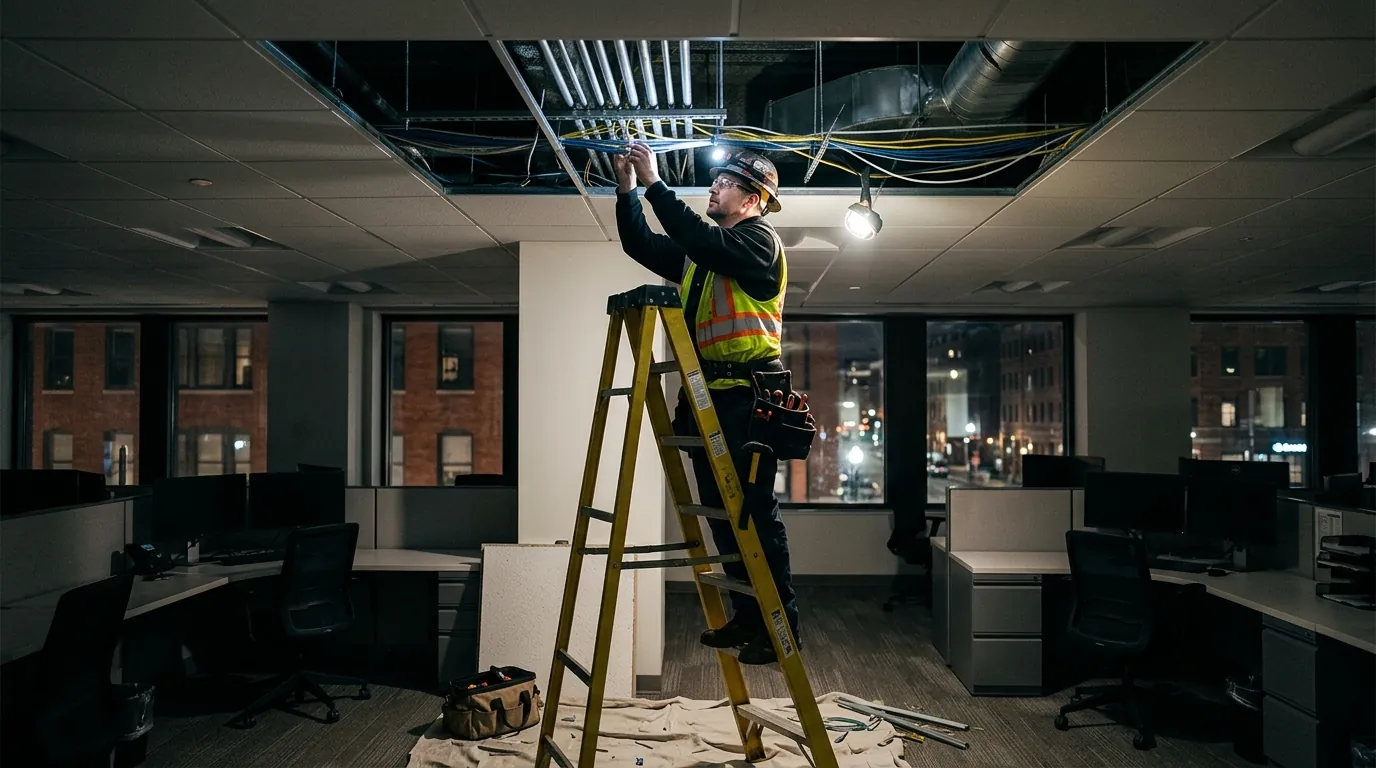
Dead receptacles at a checkout, a tripping circuit that feeds a server closet, or a row of lights out over a sales floor are the everyday calls. We find the fault at the device, the panel or the run, and repair it with as little disruption to the space as possible. Older buildings often hide splices above drop ceilings and inside storefront window boxes, which is where many faults turn up. If the repair needs the power off for a whole panel, we tell you how long and offer an after-hours slot so the store or office keeps working.
Three-phase equipment
When a three-phase motor hums but will not start, runs hot or trips its overload, the cause is often a lost phase, a loose terminal or a failed contactor rather than the equipment itself. We measure voltage and current on each leg, check the breaker and the disconnect, and look for imbalance that points back to the panel or the utility. Common equipment includes rooftop HVAC, compressors, kitchen gear and shop machinery. Running a three-phase motor on a missing phase damages it fast, so shutting it down and calling early limits the repair to the electrical side.
After-hours shutdown work
Panel replacements, breaker additions in a crowded board and service repairs all need the power off. Doing them during business hours means closing. We plan shutdown work for nights, early mornings or weekends, confirm which loads will go down, and coordinate with your landlord, alarm company and any equipment that needs a controlled restart, such as coolers or servers. Night work costs more per hour than daytime work, but for most businesses it is still less than a day of lost sales. Larger shutdowns may also need the utility or the building manager on the schedule.
Need the power off without closing? Call and we will schedule it after hours.
Call (617) 843-6591Permits and code for Boston commercial work
Business owners usually call us because something stopped working during open hours, but the fix still has to go on the record. For commercial jobs in Boston, Inspectional Services handles the electrical permits and inspections, the same office that covers homes. The statewide rulebook is the 2023 NEC, adjusted by Massachusetts amendments, and it applies to storefronts and offices as much as to houses. We pull the permit for work that requires one and book the inspector around your schedule, so a landlord or the next tenant can see the work was signed off.
How long commercial work keeps you down
Most commercial repairs take a single visit of a few hours. After-hours shutdowns for panel or service work are planned to fit inside one night or a weekend window, and we confirm the restart time before power goes off. If a part has to be ordered, we make the equipment safe first and return to finish once it arrives.
What decides the cost of commercial electrical work
Commercial jobs are priced on the repair, the hours it has to happen in and how the building is wired. These factors move it most.
- Time of day. Night and weekend shutdowns cost more than daytime work on the same repair.
- Service type. Three-phase troubleshooting and parts take longer than single-phase work.
- Access. Drop ceilings, high storefront ceilings and locked electrical rooms add time.
- Coordination. Landlords, building managers and the utility may all need a slot on the schedule.
- Parts availability. Commercial breakers and contactors are sometimes ordered rather than stocked.
Commercial electrician questions
Yes. We schedule shutdown work for nights, early mornings or weekends so the business can stay open during the day, and we confirm the restart time with you before the power goes off.
It often is. A lost phase, a failed contactor or a loose terminal can stop a three-phase unit. Shut it down to protect the motor and call.
Yes. We troubleshoot, repair and add circuits on three-phase panels in shops, offices and light commercial buildings, including rooftop HVAC, compressors and kitchen equipment.
If you give us a contact, we coordinate access to locked electrical rooms and any building-wide shutdown with them, so you are not carrying messages back and forth.
We file the permit on work that needs one through the city process and schedule the inspection, so the repair is on record for your landlord and the next tenant.
Yes. The phone is answered 24/7, and a store that loses power at night gets the same response as a home. We make it safe first, then plan the full repair.