Updated October 2026
Straight answer
Smart panel and load management work in Boston starts with one question: can your existing service carry an EV charger or heat pump if the big loads take turns? A load calculation under NEC Article 220 answers it. If the margin is close, a smart panel or load management device can cap total draw and often avoid a full service upgrade.
How managing load can stand in for more amps
Electrification puts big loads on houses built for small ones. A heat pump, an induction range and a Level 2 charger can each draw as much as the rest of the house combined. On paper, a 100 amp service runs out fast. In practice, those loads rarely peak in the same minute, and the code now recognizes systems that make sure they do not.
Load management uses that gap. A device measures current at the service or on specific circuits and sheds or throttles a big load, usually the EV charger, when the total approaches the limit. Smart panels do the same at every breaker, with an app that shows what is drawing power. Either can be a real alternative to more amps, but only after the calculation shows the numbers work.
Calculations, smart panels and load devices
Load calculations before adding equipment
The NEC gives a standard way to add up a dwelling load in Article 220, plus an optional method that applies demand factors to everything on the service. For an existing home, the code also allows starting from a year of actual peak demand data from the utility. We list every load you have and every one you plan, apply the method, and write down the result. That number decides whether the service is fine as it is, fine with load management, or genuinely too small. It is the cheapest part of the whole project and the step most often skipped.
Smart panels
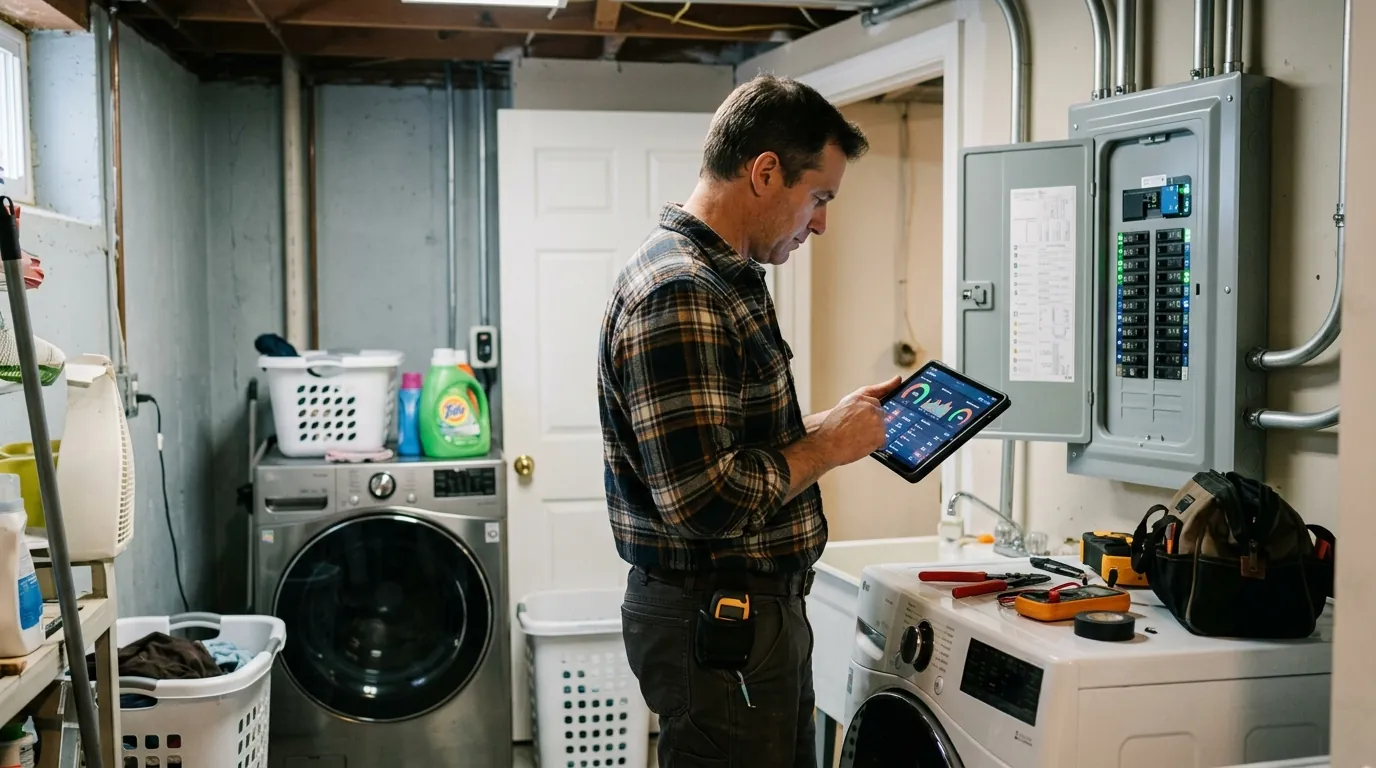
A smart panel replaces your existing panel with one whose breakers can be monitored and switched remotely. You see what each circuit draws in an app, you can set priorities so the charger pauses when the dryer starts, and some can shed loads during an outage on battery or generator power. They cost more than a standard panel and depend on software and a network connection for the clever parts. For a house going all electric, or adding a battery, the monitoring alone often justifies it. For a house adding one charger, a simpler device usually does the job.
EV load management devices
An EV load management device sits between the charger and the panel, or talks to the charger directly, and reads current on the service conductors. When the house draws close to the limit, it lowers the charging rate or pauses it, then resumes when demand drops. The NEC treats a properly listed energy management system as a way to size the charger at the managed limit rather than its full rating. Overnight charging rarely notices the difference. The trade-off is slower charging on the evenings when the oven, dryer and heat all run together.
Adding a charger or heat pump? Ask for the load calculation first.
Call (617) 843-6591What sets the scope of a load management job
Load management is priced by which approach the calculation supports, and each one has a very different scope.
- The approach. A charger-level load device is a small job; a smart panel replaces the panel itself.
- Panel condition. If the existing panel is a problem brand or full, a smart panel replacement does double duty.
- Number of managed loads. Managing only the charger is simpler than prioritizing a heat pump, range and dryer as well.
- Network setup. Smart panels need a reliable Wi-Fi signal at the panel location, which basements do not always have.
- Program paperwork. Some incentive programs ask for documentation of the equipment and the load calculation.
Upgrade the service or manage the load?
Three ways to fit an EV charger or heat pump onto an existing service, compared on what usually decides it.
| Option | What changes | Trade-off |
|---|---|---|
| 200 amp service upgrade | Panel, meter socket, service conductors | Most capacity, utility and inspection scheduling, longest outage |
| Smart panel | Panel replaced with monitored breakers | Control of every circuit, higher equipment cost, app dependent |
| EV load management device | A device added at the charger or panel | Smallest job, slower charging when the house is busy |
Incentive programs that affect the choice
Switching to heat pumps is where load management starts paying for itself. Mass Save puts incentive money toward heat pumps, but which homes and equipment qualify gets revised annually, so check the current program before planning around it. On the electrical side, plenty of older Boston services were sized for lights and a refrigerator, and they look too small once heat pumps, an induction range and an EV charger are on the list. A smart panel or a load management device can let the existing service carry that mix by pausing one load while another runs, which sometimes avoids a service upgrade.
From load calculation to tested limits
Gather the loads
We record nameplates on existing equipment and specs for what you plan to add.
Run the calculation
Article 220 method, with utility demand data where it helps, written up for you.
Compare the paths
Service upgrade, smart panel or load device, side by side for your house.
Install and set limits
Equipment installed, current sensors placed and the managed limit configured.
Test under load
We run the big loads together and confirm the system sheds as set.
Smart panel and load management questions
Often, yes, with a load calculation and either a lower charger setting or a load management device. It depends on what else the house runs, especially electric heat or a heat pump.
Sometimes. It manages loads so they stay within the service, but it cannot create capacity. If the calculation shows you need more than the service provides even with management, you still need the upgrade.
The device slows or pauses charging until demand drops, then picks back up. Overnight charging usually finishes well before morning, because evening cooking and laundry loads have ended by then.
The code sets how a service is sized and recognizes listed energy management systems, and the inspector reviews the installation. Utility and incentive programs have their own requirements, so check those before choosing equipment.
The panel itself has no power without the utility, a generator or a battery. Paired with backup power, many can shed noncritical circuits so the backup lasts longer.