Updated October 2026
Straight answer
Recessed lighting in a Boston house is usually a canless LED wafer that clips into a small round hole and runs on a thin remote driver. In a plaster ceiling we map joists first and cut cleanly to avoid cracking keys. Under an insulated attic, every fixture must be IC rated so it can sit in contact with insulation.
Planning downlights around joists and what sits overhead
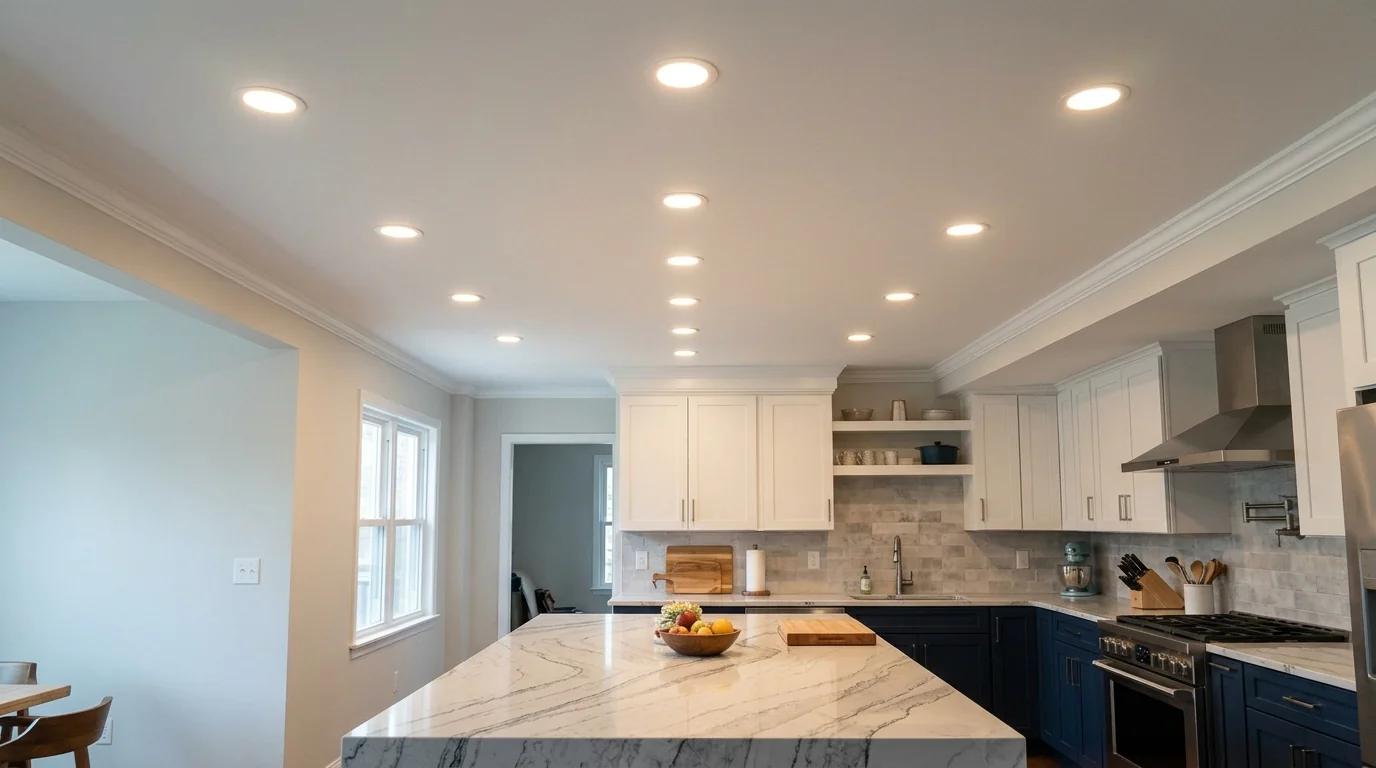
Most recessed jobs we see are a living room or kitchen lit by one center fixture that someone wants to replace with an even grid of downlights. The work is part layout and part fishing wire. Spacing comes from the ceiling height and the room use, then gets adjusted to where the joists actually run, because a light that lands on a joist has to move.
The second half of the decision is what sits above the ceiling. A finished floor above, an unheated attic, a bathroom vent duct or an old plumbing run each change which fixture fits and how we get cable to it. We open the ceiling as little as possible, and we tell you up front if any patching will be needed.
Choosing the right recessed fixture for the ceiling
Canless LED wafers
Canless wafers have mostly replaced old metal cans in remodels. The fixture is about an inch thick, clips into a round cut with spring arms, and plugs into a small junction box driver that rests on the ceiling beside it. Because they need so little depth, they fit under joists, ducts and shallow framing that would stop a can. The trade-off is that the light and driver are one unit: if the LED fails years from now you replace the wafer, not a bulb. We buy wafers with selectable color temperature so the whole room matches, and we check that each one is rated for your dimmer before the first hole is cut.
Plaster ceiling installs
Plaster on wood lath is common in older Boston houses, and it does not cut like drywall. A dull blade or a hammer drill can shake the plaster keys loose and crack a ceiling well beyond the hole. We locate joists with a scanner and small test holes, score the finish, and cut with a sharp hole saw at low speed while holding the surface. Cable runs through the joist bays from an access point, often an existing fixture box or a closet ceiling, so most rooms need no long trench. If a run has to cross joists, we open a small strip and leave it ready for your plaster or drywall patch.
Insulation-contact rated housings
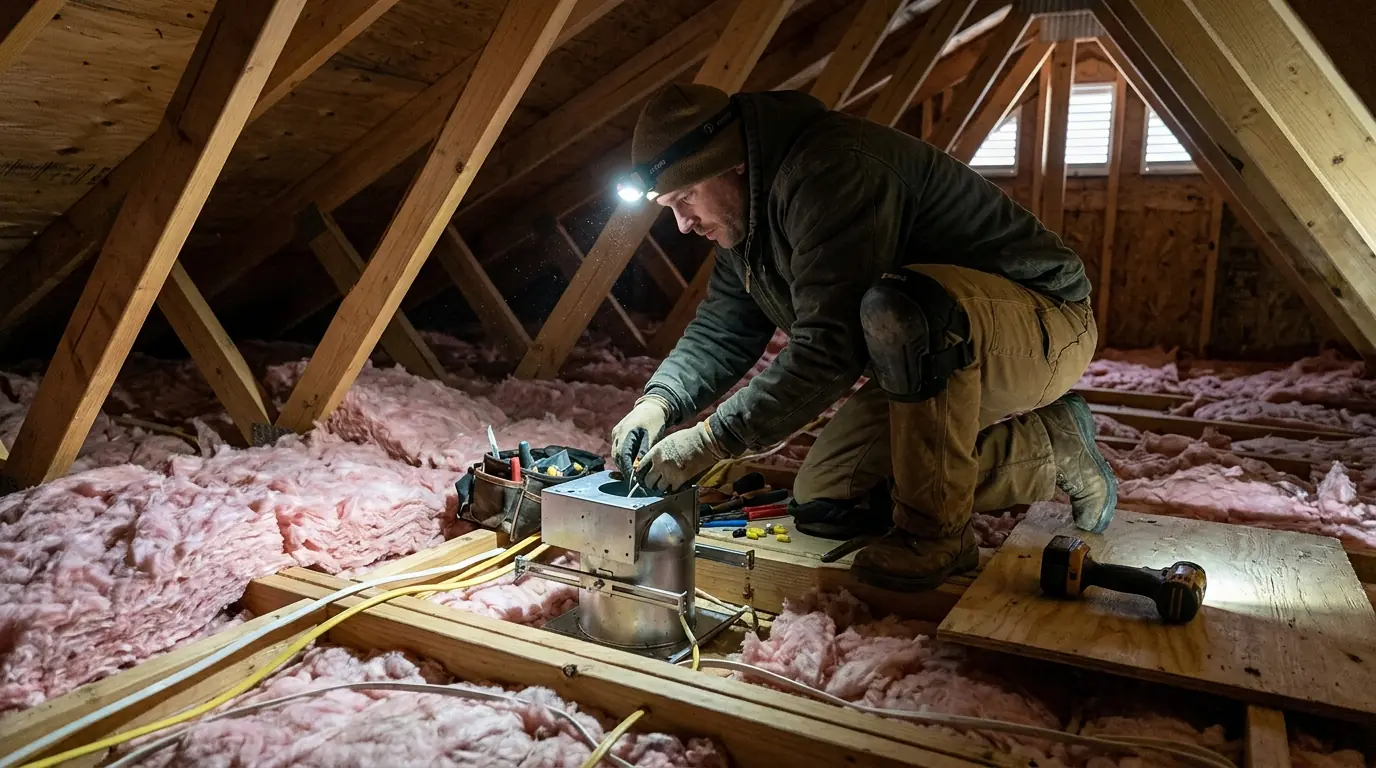
On a top floor ceiling under an attic, insulation either touches the fixture or it should. A non-IC can buried in insulation can overheat and trip its thermal cutoff, so the light switches itself off and on. Every fixture we put under insulation is IC rated, and where air leakage matters we use airtight rated housings or canless wafers that seal to the ceiling, which keeps warm house air from rising into a cold attic. If you plan to add attic insulation later, tell us now. The fixture choice has to match the insulation that will be there, not the bare attic we see today.
Thinking about a grid of downlights? We will map the ceiling first.
Call (617) 843-6591What sets the price of a recessed lighting job
Recessed lighting is priced per room after we see the ceiling and what sits above it. These are the factors that move the number.
- Number of fixtures. Each light is a cut, a connection and a driver, so a six light kitchen costs more than a four light hallway.
- Ceiling material. Plaster on lath takes slower cutting and more care than drywall.
- Access above. An open attic makes fishing easy. A finished floor above means working through joist bays from below.
- Circuit capacity. Adding many fixtures to a full lighting circuit can mean a new circuit back to the panel.
- Fixture rating. IC and airtight rated fixtures for attic ceilings cost more than standard wafers.
- Switching and dimming. New switch locations, multi-way control or new dimmers add devices and wire.
Old attic wiring and recessed lights
Cutting holes for downlights in an older Massachusetts ceiling is often the first time anyone has looked above it in decades. The state has more houses built before 1940 than most of the country, and the top-floor ceiling of such a house is a common hiding place for original wiring. If we find knob and tube up there, we won't tie new cans into it. There is a second reason to deal with it now: an energized old run stops Mass Save insulation work from going ahead, so retiring it before your attic is insulated keeps both jobs moving.
What a recessed install covers
- Layout marked on the ceiling for your approval
- Joist and obstruction scan before cutting
- IC or airtight rated fixtures where insulation is present
- Cable fished through joist bays from an access point
- Connections in rated driver boxes
- Dimmer matched to the fixture compatibility list
- Test of every fixture at low and full brightness
- Small access openings left clean for patching
How long a recessed lighting job takes
A four to six light room in drywall under an open attic is usually a one day job. The same room in plaster with a finished floor above can run longer, since fishing through joist bays is slower and some cuts need care. Whole floor layouts often take two or three days, with the circuit work done first.
From pencil marks to working lights
Walk the room
We look at ceiling height, room use and where you want light on counters, art or seating.
Map the ceiling
Joists, ducts and old wiring located with a scanner and small test holes before layout is final.
Mark and confirm
Fixture spots marked in pencil so you see the grid before anything is cut.
Cut and fish
Clean holes, cable fished through joist bays, connections made in rated driver boxes.
Set and test
Fixtures clipped in, dimmer tuned for the LEDs, and every light checked at low and full output.
Recessed lighting questions from homeowners
A common starting point is spacing roughly half the ceiling height between lights, so about four feet apart under an eight foot ceiling. We adjust for the room use, the joists and the walls, since lights too close to a wall throw harsh scallops.
Usually, yes. We locate joists first, cut slowly with a sharp saw while supporting the surface, and fish cable through the joist bays. Some rooms need a small access strip, and we tell you before we start.
You do on any ceiling where insulation touches or could touch the fixture, such as a top floor under an attic. Between finished floors IC rating matters less, but we often use rated fixtures anyway so the choice never limits future insulation work.
Sometimes. Many older dimmers were designed for incandescent loads and flicker or hum with LEDs. We check the fixture compatibility list and swap the dimmer when it is not a match.
Yes, with fixtures rated for damp locations, and a wet rated trim over a tub or shower. We also keep them clear of the vent fan duct in the ceiling.
The whole wafer is replaced, since the LED and trim are one unit. It clips out of the same hole and plugs into the same driver box, so it is a short job.