Updated October 2026
Straight answer
GFCI and AFCI protection in Boston homes covers two different risks: a GFCI cuts power when current leaks to ground through a person, and an AFCI trips when it detects arcing from a damaged or loose wire. We add GFCI outlets or breakers in kitchens, baths and laundry areas, AFCI breakers on bedroom circuits, and fix two-prong outlets in the ways the code allows.
Two kinds of protection for two different risks
A GFCI compares the current going out on the hot wire with the current coming back on the neutral. If a few thousandths of an amp go missing, possibly through someone touching a faulty appliance at a wet sink, it trips in a fraction of a second. An AFCI watches the current for the signature of arcing, the kind that happens when a nail nicks a cable or a backstabbed connection loosens. Neither replaces the other, and dual-function devices do both jobs.
Older houses usually have neither, and their wiring raises its own questions. A GFCI works on a two-wire circuit without a ground, which makes it one of the legal fixes for two-prong outlets. AFCIs can be harder on old wiring, since shared neutrals and old splices cause trips. When an AFCI keeps tripping on an old circuit, the device is often doing its job, so we find the fault instead of removing the breaker.
Where GFCI and AFCI go in an older house
Kitchen, bath and laundry GFCI
Kitchen counters, bathrooms, laundry areas, basements, garages and outdoor outlets all call for GFCI protection, and recent code editions have widened the list. We choose between a GFCI receptacle at the first outlet on a circuit, which protects everything wired after it, and a GFCI breaker in the panel, which protects the whole circuit from the start. Receptacles are easy to reset right at the counter. Breakers keep the backsplash cleaner and end the hunt for which outlet tripped, but you reset them at the panel. Either way, we label the downstream outlets so nobody decides the far bathroom outlet is dead when the protecting device has simply tripped.
Two-prong outlet upgrades
A three-prong outlet installed on a circuit with no ground is one of the most common home inspection write-ups. The code, in NEC 406.4(D), gives you a few legal routes. You can run a grounding conductor back to the panel or another grounded point, then install a true grounded outlet. You can install a GFCI receptacle, or protect the outlet from a GFCI upstream, and mark it as having no equipment ground. Or you can replace it with another two-prong outlet. GFCI makes the outlet safer for people, but it does not give surge protectors or computer gear a real ground, so for a home office we usually run the ground.
AFCI breakers for bedrooms
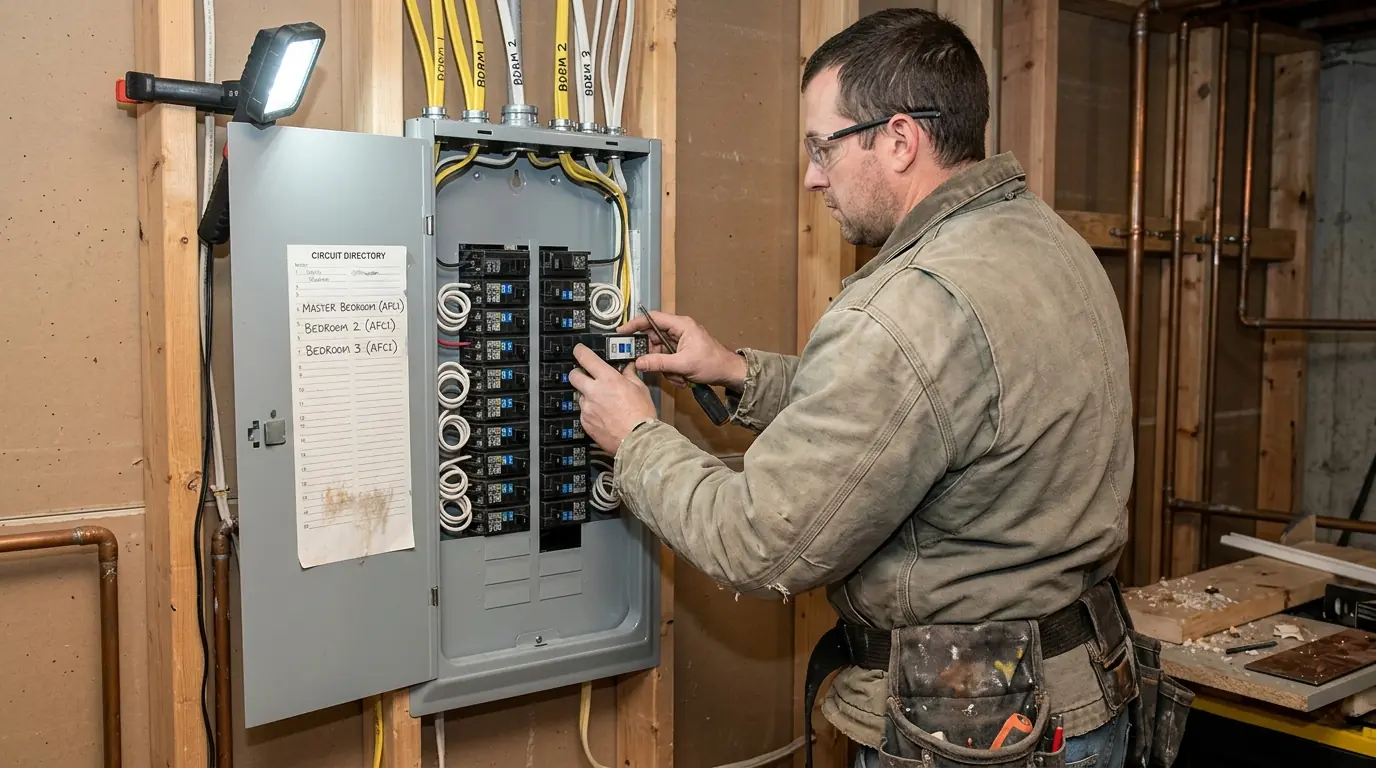
Bedrooms were the first rooms to get AFCI requirements, because fires from damaged cords and wiring near beds were a known pattern. The code now calls for AFCI protection on most living areas for new circuits, and on bedroom circuits when existing wiring is extended or modified. We install AFCI or dual-function breakers listed for your panel, since breakers from another maker are not approved for it. On older circuits, an AFCI that trips repeatedly often points to a shared neutral, a loose splice or a damaged cord. We trace the cause rather than putting a standard breaker back in, which would only hide the problem.
Two-prong outlets on your inspection report? Call and we will sort them out.
Call (617) 843-6591Massachusetts rules and two-prong Boston outlets
Two-prong outlets are still common in Boston houses that kept their original plaster walls, and they're the reason many owners call us about GFCI and AFCI. Swapping in a three-prong outlet without a ground just hides the problem. A GFCI at the first outlet on the run can protect everything downstream and allow three-prong devices with the proper labels, while AFCI protection at the breaker watches for the arcing that old, brittle insulation can produce. Damp basements and outdoor outlets in the salt air near the harbor wear devices faster, so we test every one after installation.
What changes the cost of adding protection
GFCI and AFCI work is priced by the device and by what the old circuits turn up once protection is added.
- Receptacle or breaker. GFCI and AFCI breakers cost more than receptacles but protect a whole circuit from the panel.
- Panel brand and age. Some older panels have few or no AFCI breaker options, which can force a panel decision.
- Number of locations. One GFCI can protect a run of downstream outlets if the wiring order allows it.
- Running a ground. Adding a grounding conductor to two-prong outlets means fishing wire back to a grounded point.
- Faults found. An AFCI that trips on install exposes wiring problems that need repair first.
How we add protection circuit by circuit
Map the circuits
We find which outlets share a circuit and in what order they are wired.
Choose the device for each spot
Receptacle, breaker or dual-function, based on access and your panel.
Install and trip-test
Every GFCI and AFCI is tested with its own test button and a plug-in tester.
Label protected outlets
Downstream outlets and any ungrounded outlets get the required markings.
Show you the resets
We point out where each reset is and how to test it monthly.
Three legal fixes for a two-prong outlet
For a two-prong outlet with no ground, the code recognizes three choices, and each suits a different room.
| Option | What you get | Best for |
|---|---|---|
| Run a ground, install a three-prong outlet | A true equipment ground | Home offices and surge-protected electronics |
| GFCI protection, marked no equipment ground | Shock protection and three-prong plugs fit | Bedrooms, living rooms and kitchens without a ground |
| Replace with a two-prong outlet | Same as before, nothing added | A short-term fix before a rewire |
Testing you can do and work to leave alone
Safe for a homeowner
- Press test and reset on each GFCI once a month
- Check that downstream outlets go dead when you test
- Use a plug-in tester to spot open grounds
- Note which outlets lose power when an AFCI trips
Leave to an electrician
- Replacing a two-prong outlet with a three-prong one
- Installing GFCI or AFCI breakers in the panel
- Fixing an AFCI that trips repeatedly
- Sorting line and load wires on a GFCI outlet
Older GFCIs could be wired with line and load reversed and still deliver power with no protection, so an old unit that never trips when tested should be replaced.
GFCI and AFCI questions
Only with GFCI protection and a label saying there is no equipment ground, or after a grounding conductor is added. A plain three-prong outlet with no ground and no GFCI is a code violation and a common inspection write-up.
GFCI protects people from shock by detecting current leaking to ground. AFCI protects against fire by detecting arcing in wires and cords. Dual-function devices give both kinds of protection on one circuit.
Usually a shared neutral, a loose splice, a damaged cord or an old appliance motor. The breaker is reacting to something real or to a wiring arrangement it cannot tolerate. We trace it rather than swap back to a standard breaker.
Buyers and home inspectors look for it in kitchens, baths and outdoors, and ungrounded three-prong outlets get written up. Adding protection before listing removes an easy item from the inspection report.
Yes, if those outlets are wired from its load terminals. A single GFCI at the start of a bathroom or kitchen run can protect several outlets after it, and we label each one.
Monthly is the common manufacturer recommendation. Press test, confirm the power goes off, then press reset. If it will not trip or will not reset, the device needs replacing.