Updated October 2026
Straight answer
Knob and tube wiring replacement in Boston usually starts because an insulation contractor found live wiring in the attic or walls and stopped work. Mass Save treats live knob and tube as a pre-weatherization barrier, so the insulation waits. We trace which old runs are still energized, rewire those circuits with grounded cable, and disconnect the old wiring so the job can move forward.
Why knob and tube stops insulation and what we do about it
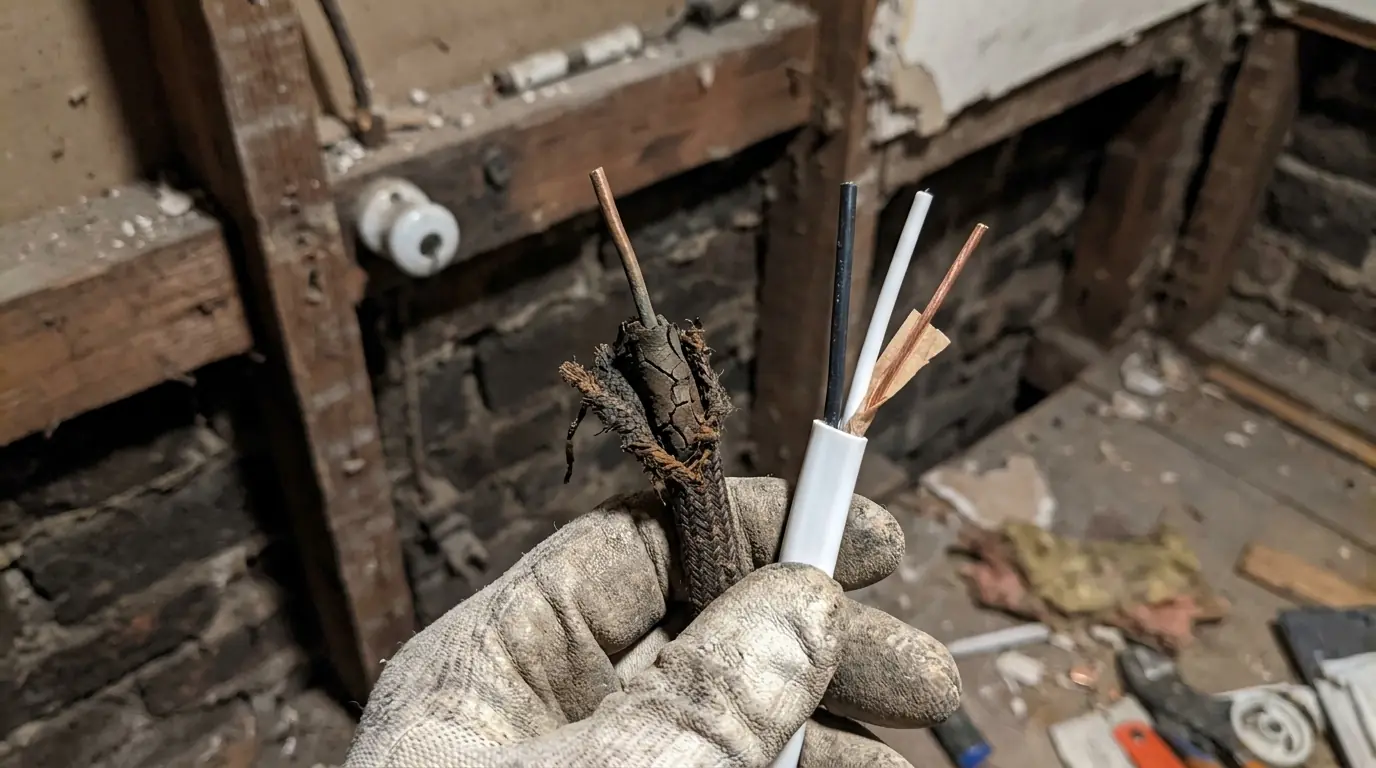
Knob and tube was designed to shed heat into open air. The two conductors run separately on porcelain knobs and through porcelain tubes, with no ground, and the rubber and cloth insulation on century-old runs is often brittle. Bury that wiring in blown-in cellulose and it can no longer cool itself, which is why insulation programs will not cover it. Decades of add-ons make it worse, since newer cable was often spliced onto old runs in the attic with tape.
The job starts with finding out what is actually live. Many houses have knob and tube that was abandoned years ago lying next to runs that still feed a bedroom or the front hall lights. We test at the panel, in the attic and at the devices, and tag each old run as live or dead. Live circuits get replaced. Dead runs are confirmed dead and disconnected at both ends, so the next contractor does not have to guess.
Where the old circuits are and how much to replace
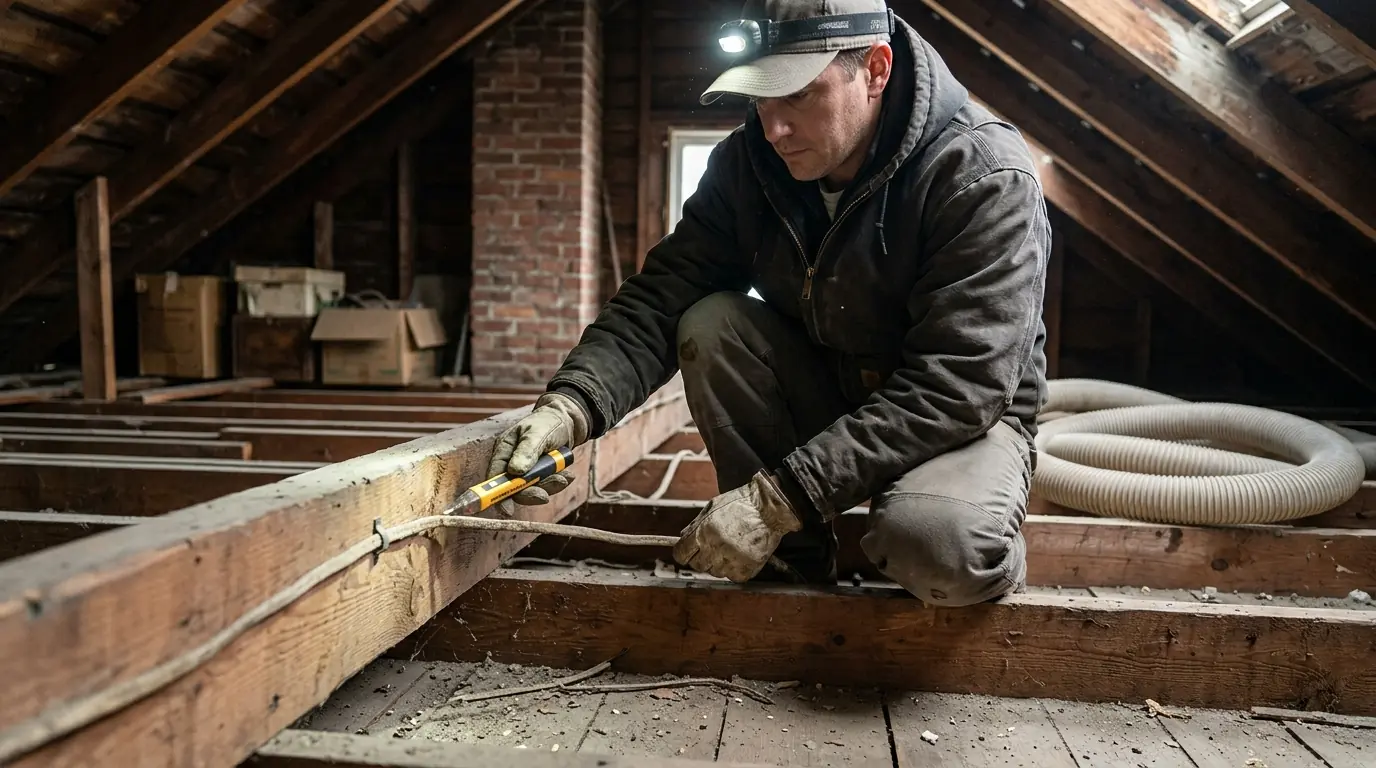
Live knob and tube in attics
The attic is where knob and tube is easiest to see and most often still live. Look for pairs of single wires on white porcelain knobs across the joists, sometimes with a newer cable spliced onto them. Top floor ceiling lights and the outlets in the walls below are often fed from those runs. We replace them with new cable fastened to framing or run in a protected path, re-feed each ceiling box and device, and remove the old splices. Attics are quick to work in compared with walls, but low clearance, old loose fill and floorboards over the joists can slow the job, and some insulation may need moving first.
Insulation-blocking circuits
When an energy auditor flags knob and tube, they usually mean specific runs: the ones in the attic floor and the exterior walls that are about to be filled. Those are the circuits we deal with first, because they are what stands between you and the insulation. We document which runs were replaced and confirm the old wiring is disconnected. Interior walls that will not be insulated can wait if your budget needs it, though those circuits still lack a ground. Ask your weatherization contractor exactly what they need from the electrician before we start, so our paperwork matches their checklist.
Partial versus full removal
A partial job replaces the circuits blocking insulation and any that are failing, and leaves the rest of the knob and tube for a later phase. A full job replaces every remaining knob and tube circuit in the house. Partial costs less now, but it leaves you with two wiring systems and a panel directory that needs care. Full replacement in plaster walls means fishing new cable, the same work as a whole-house rewire, and it settles the question for insurers and buyers. Either way, old runs are disconnected at the panel. Pulling dead wire out of closed walls is rarely worth the damage, so it usually stays in place, dead.
Insulation job on hold for old wiring? Call and we will trace it.
Call (617) 843-6591What changes the cost of knob and tube replacement
Knob and tube replacement is priced on how many live circuits remain and how easy they are to reach.
- Live circuits remaining. Each energized run needs new cable from the panel to every device it fed.
- Attic versus wall runs. Open attic work goes quickly, while fishing cable down plaster walls takes much longer.
- Existing insulation. Old loose fill over the runs has to be moved or worked around before we can see the wiring.
- Scope you choose. Replacing only insulation-blocking circuits costs less than replacing every remaining run.
- Panel condition. A fuse box or a full panel may need replacing before it can take the new circuits.
- Patching needed. Wall runs that cannot be fished mean small openings to patch afterward.
Choosing how much knob and tube to replace
Once the live runs are mapped, most homeowners pick one of three levels of work.
| Option | What it covers | Trade-off |
|---|---|---|
| Insulation-blocking runs | Attic floor and exterior wall circuits | Other old circuits stay for later |
| All live circuits | Every run still energized anywhere | More fishing now, dead wire left in walls |
| Full replacement plus additions | All knob and tube plus new outlets where needed | Largest job, ends the question |
Knob and tube in Boston attics
Plenty of Boston owners first hear about their knob and tube during an energy audit. The city names that wiring as one of the things that block insulation from going in, so a house with live runs in the attic or outside walls cannot get blown-in insulation until the old circuits are out of service. So the rewiring comes before any insulation crew shows up; it is not an add-on. We find every live run, replace or abandon it, and leave the attic clear so the insulation work can start right after us.
How a knob and tube job runs
Trace and test
We find every old run and test whether it is still energized.
Agree the scope
You choose between the insulation-blocking circuits now or all remaining knob and tube.
Run new circuits
Grounded cable goes from the panel to each ceiling box, outlet and switch on those circuits.
Disconnect old wiring
Old runs are cut off at the panel and at reachable ends, then retested dead.
Document for the insulator
You get a written list of what was replaced and what was disconnected.
What you can check before we arrive
Safe for a homeowner
- Look in the attic with a flashlight without touching the wiring
- Count the two-prong outlets room by room
- Keep stored boxes off any knobs you see
- Tell your insulation contractor what you found
Leave to an electrician
- Testing whether a run is live
- Cutting or disconnecting any old wire
- Moving insulation that is touching the wiring
- Splicing new cable onto old conductors
Old insulation on knob and tube can crack when the wire is bent, so look but do not handle it.
How to tell if your house still has it
Porcelain knobs on attic joists
Single wires on white spools, often running across the attic floor.
Two-prong outlets throughout the house
No ground slot often means original wiring behind the plate.
Cloth or rubber insulation that flakes
Visible when an old outlet or ceiling fixture comes off.
An insulation job stopped for wiring
The auditor or installer found live knob and tube in the work area.
Fuses or a very small old panel
Knob and tube usually came with fuse-era electrical service.
Knob and tube questions
Not on its own if it is intact, uncovered and not overloaded. The danger comes from brittle insulation, careless splices added over the years, the lack of a ground, and insulation packed around wires that were designed to cool in open air.
Insulation programs care about live wiring. If the old runs are disconnected at the panel and confirmed dead at the ends, that is usually what the installer needs. Check their exact requirement with them before we start.
Attic runs rarely need any opening. Circuits in plaster walls are fished from above and below where possible, and small openings are cut only where framing blocks the path.
You often cannot tell by looking. Some houses have abandoned runs lying beside live ones. We test each run with the power on, then confirm it reads dead after we disconnect it.
Many insurers ask about knob and tube when writing or renewing a policy. Replacing the live circuits and keeping the paperwork gives you a clear answer for them, though each company sets its own rules.
Not necessarily. Many owners replace the insulation-blocking circuits first and the rest during a later renovation. What matters is that no live knob and tube ends up buried in insulation.