Updated October 2026
Straight answer
Electrical troubleshooting in Boston starts at the panel, because a dead or flickering circuit is fed from one breaker and one path of wire. We map which outlets and lights share that breaker, test voltage under load at each one, and find the loose splice, failed device or worn breaker behind it. Most faults turn out to be a single bad connection.
Clues the problem is in the wiring
Lights dim when appliances start
Voltage is sagging, often from a loose neutral or service connection.
A run of outlets went dead together
One connection upstream has opened, usually inside a device box.
Breaker trips with nothing new plugged in
The circuit has developed a fault, or the breaker is wearing out.
A switch that crackles
Arcing at a terminal, which builds heat inside the wall box.
How we track a fault to its source
Symptom history
We ask when it happens, what else was running and what has changed recently.
Circuit map
We identify the breaker and every outlet and light it feeds.
Load testing
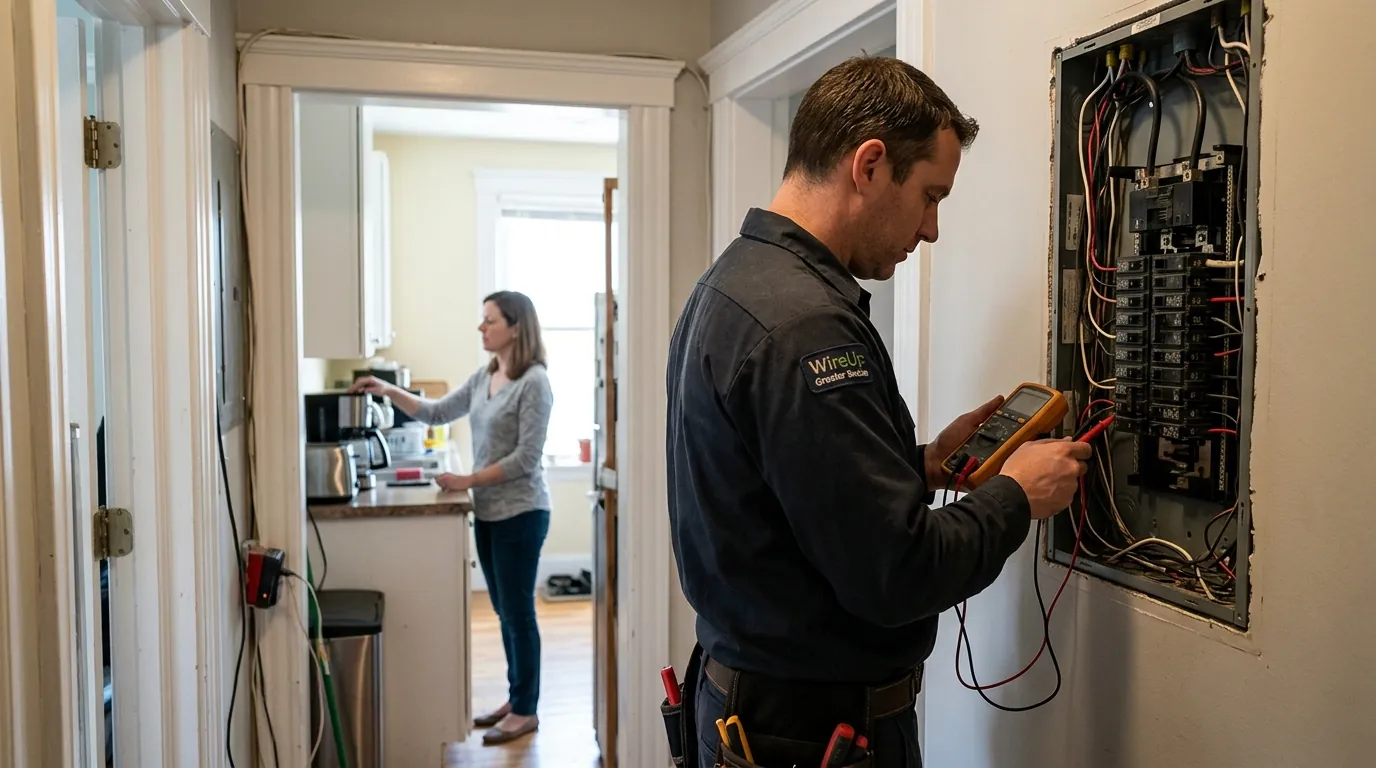
Voltage is checked with a load applied, which exposes connections that read fine at rest.
Isolate the fault
We split the circuit into sections until the failed joint, device or cable turns up.
Repair and retest
The fault is fixed and the whole circuit is tested again under load before we leave.
Why electrical faults hide in older wiring
Intermittent problems are the hard ones. A light that flickers only when the dryer runs, or a bedroom outlet that works in the morning and quits by evening, is telling you a connection is loosening and tightening with heat. Replacing the obvious device rarely fixes it, because the bad joint is often one or two boxes upstream, where power passes through on its way to the dead outlet.
Our approach is to prove the cause before changing parts. We note every symptom you've seen, identify the circuit, and check voltage with a load applied, since a loose wire can read normal with nothing plugged in. In older Boston houses we also look for the splices previous owners added, which are often the weak link in a run that otherwise looks original.
Symptoms we trace most often
Flickering lights
One fixture that flickers usually has a loose bulb, a worn socket or a dimmer that doesn't suit LED lamps. Flicker across several rooms is a different problem, especially when it follows a large appliance starting up. That pattern points to a loose connection on a shared neutral, in the panel or at the service itself, and it gets worse over time as the joint heats. We separate the two by watching voltage at the panel while loads switch on and off. A single fixture fix is short. A neutral or service problem takes longer, and if the fault sits on the utility side we tell you exactly what to report to Eversource.
Dead outlets on one circuit
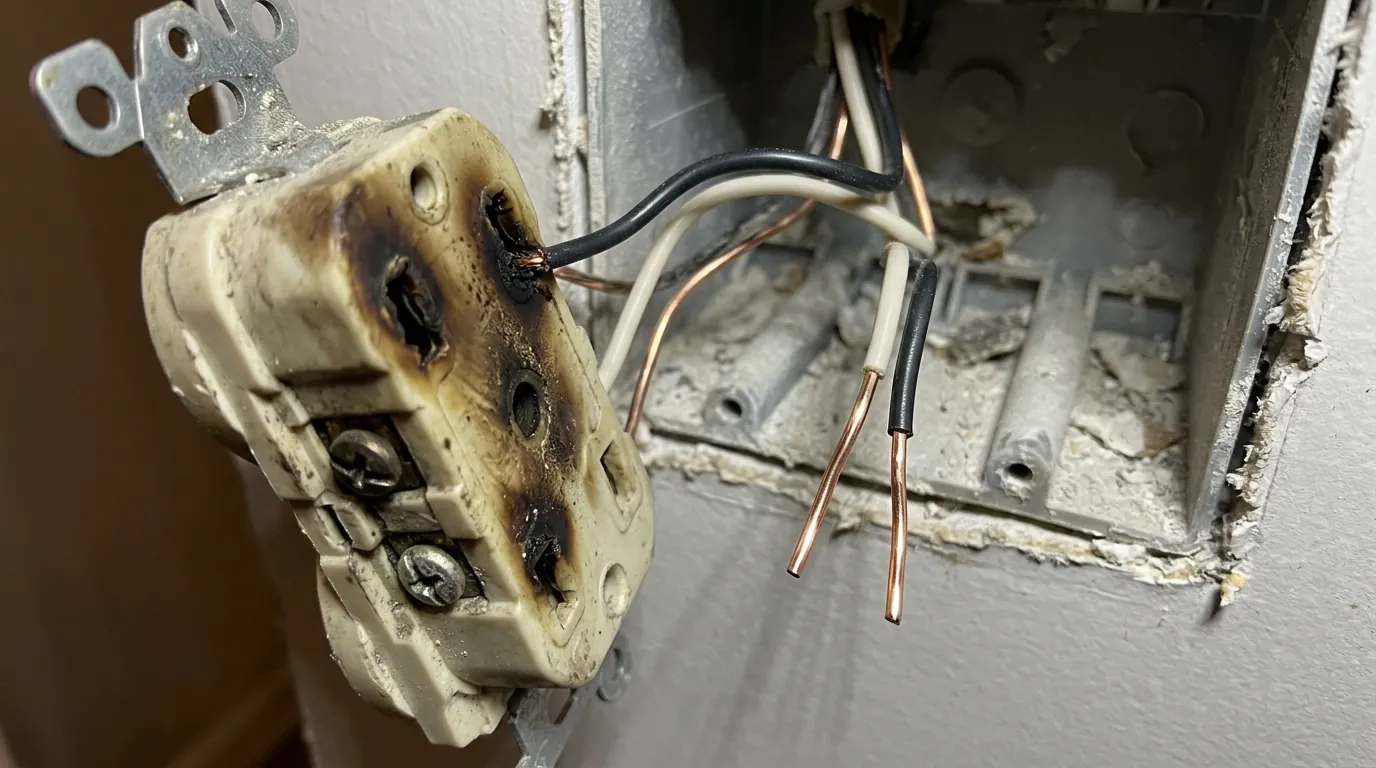
When a string of outlets goes dead while the breaker still shows on, the break is almost always at one device in the chain. Power enters the first box and is carried to the next through the device terminals or a splice, so one burned backstab connection kills everything downstream. Before opening anything, we check for a tripped GFCI somewhere unexpected, such as a bathroom or basement outlet that also protects a bedroom. Then we work from the last live outlet to the first dead one. The repair is usually rewiring that box with pigtails, and the trade-off is time: finding the box takes longer than fixing it.
Breaker that will not reset
A breaker that snaps back off the instant you push it, or won't latch at all, has either found a short or failed internally. We disconnect the circuit wiring at the breaker and test it on its own. If the wire tests clean between hot, neutral and ground, the breaker itself is suspect and gets replaced with a type listed for your panel. If the wire shows a fault, we isolate sections until the damaged run, a nail through a cable or a crushed cord turns up. Please don't hold the handle on to force it. That pushes current straight through the fault and heats whatever is damaged.
Buzzing switches
A light switch that hums is usually a dimmer working against a load it wasn't built for, most often LED bulbs on an old incandescent dimmer. That is annoying but not dangerous. A buzz or crackle from a standard toggle switch is another matter. It means arcing at a loose terminal or inside a worn switch, and the plate may feel warm. We pull the device, inspect the wire ends for darkening, cut back to clean copper and install a new switch, or a dimmer rated for the bulbs you use. Fixing a dimmer hum can also mean changing bulbs so the two agree.
Lights flickering or a circuit dead? Call and we will trace it.
Call (617) 843-6591Checks to make before you call
Safe for a homeowner
- Check every GFCI outlet in the house, including bathrooms, garage and basement
- Reset a tripped breaker once by pushing it fully off, then on
- Write down which outlets and lights are dead
- Unplug devices on the affected circuit before resetting
Leave to an electrician
- Opening outlet or switch boxes to chase a dead circuit
- A breaker that trips again right away
- Flicker that affects more than one room
- Any warm, scorched or crackling device
If lights across the house brighten and dim together, turn off sensitive electronics and call, because a loose neutral can send damaging voltage to anything plugged in.
Troubleshooting a house wired in layers
Most Boston houses were wired in stages. A kitchen redone in the nineties, a bath from the seventies, an attic room someone finished later, and original runs still feeding a hallway or two. A dead circuit can pass through several of those layers before it reaches the breaker, and the splice that failed is often buried behind plaster and lath with no box to open. That is why we map the circuit with a tracer and meter before cutting anything. When we do open a wall, it is one small hole at the right spot, and the repaired splice ends up in an accessible box.
How long finding the fault takes
A single dead circuit or buzzing switch is usually found and fixed in one visit of an hour or two. Intermittent flicker can take longer, because the fault has to be caught while it is happening, and we may ask you to note times and conditions. A fault traced to the utility side waits on Eversource for the final repair.
What decides the cost of troubleshooting
Troubleshooting is priced on the time spent finding the fault plus the repair itself, and you hear the repair cost before we start it.
- How intermittent it is. A fault that shows up on demand is found faster than one that appears only on cold nights.
- Circuits involved. One dead circuit is a short trace, while house-wide flicker can mean testing the service and several runs.
- Wall and ceiling access. Plaster, finished basements and boxes behind cabinets add time to reach a splice.
- What the fix turns out to be. A loose terminal is a small repair, while a damaged cable inside a wall may need replacing.
- Hidden splices. Older houses often have buried junctions that must be brought into an accessible box.
- Visit timing. Night and weekend calls cost more than a scheduled weekday visit.
Electrical troubleshooting questions
Outlets on a circuit are wired in a chain, so one failed connection cuts power to everything after it. A tripped GFCI in another room can do the same thing, so check those first.
It can be. House-wide flicker tied to appliances starting often means a loose neutral or service connection, which can push high voltage to some circuits. Unplug electronics and call.
Usually, yes. We load test the circuit to make a loose connection show itself, and we check splices and terminals for heat discoloring even when the fault isn't active.
Only where the trace leads. We test from accessible boxes first and open plaster at the point we've confirmed, rather than cutting exploratory holes.
The timing usually lines up with a load, such as a space heater, dehumidifier or bedroom air conditioner. That points to an overloaded circuit or a worn breaker, and testing separates the two.