Updated October 2026
Straight answer
Commercial EV charging in Boston starts with a load calculation on the building service, because that number decides how many Level 2 ports you can add. Load management lets several chargers share one circuit or a capped total, so a workplace lot or condo garage can often add charging without a utility service upgrade.
Capacity and distance decide every charging project
Every site has two limits: how much spare capacity the building service has, and how far the chargers are from the electrical room. The first decides how many chargers can run at once. The second decides how much conduit and trenching the job needs, which is often the largest part of the cost in a parking lot.
Load management changes the math. Instead of sizing for every charger at full output, managed chargers share power and slow down when the building load is high. Most cars sit for hours at work or overnight at home, so a slower charge is rarely a problem. We also plan conduit for future ports now, because opening a lot or a garage ceiling twice costs more than doing it once.
Charging for workplaces, residents and shared lots
Workplace charging
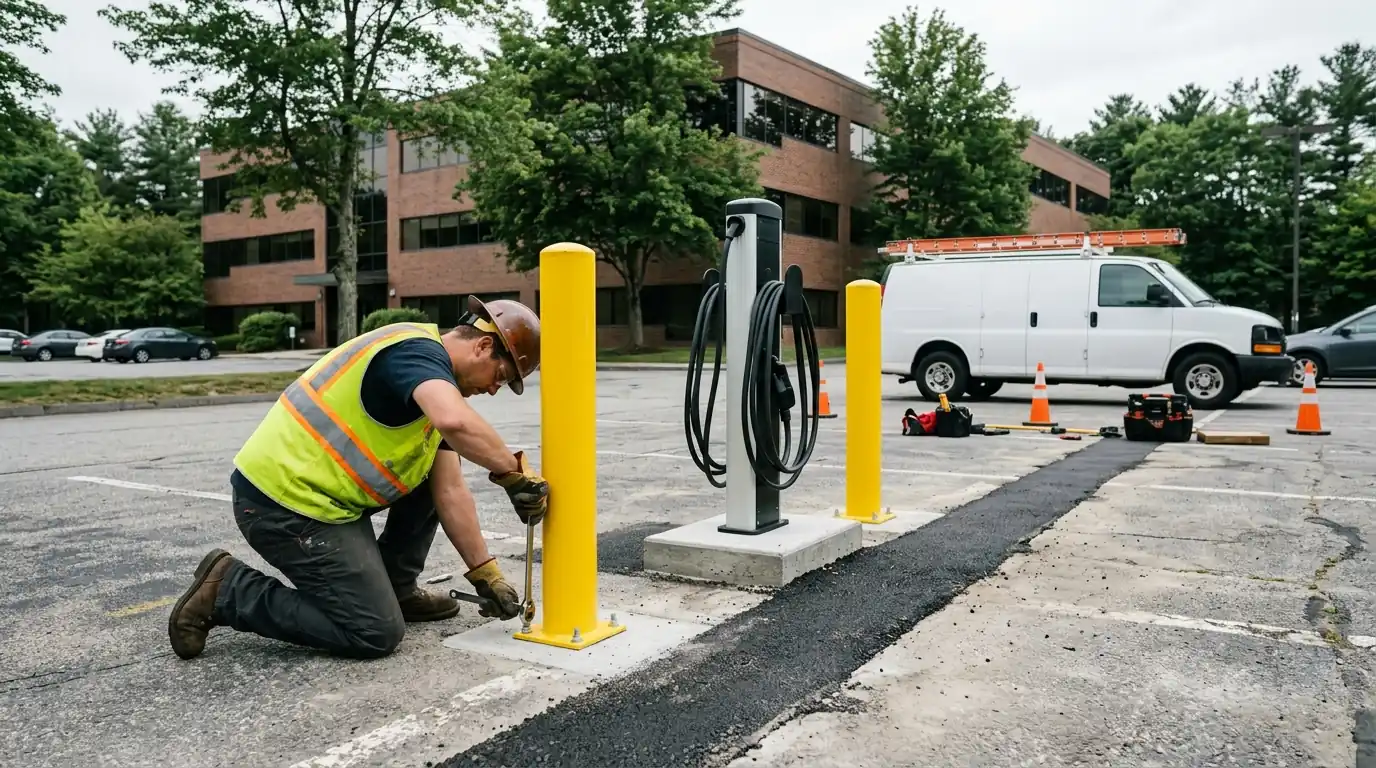
Office and commercial lots usually need a handful of Level 2 ports near the building first, with room to grow. Employees park for a full workday, so modest charging rates per car work well and keep the load down. The main decisions are where the chargers go, who pays for the electricity, and whether access should be limited to staff. We look at the service, the distance to the parking spaces and the surface we have to cross. Surface-mounted conduit on a building wall is far cheaper than trenching across asphalt, so placement near the electrical room saves money.
Multi-family parking chargers
Condo and apartment garages raise questions a workplace does not. Each resident wants charging at their own space, the association wants a fair way to bill electricity, and the building service is shared by every unit. Running a separate circuit to each space from each unit panel is rarely practical. A common approach is a dedicated charging panel fed from the house service, with managed chargers that split capacity and track use per driver. We work with the board or the property manager on how many spaces to wire now and how much conduit to leave for later.
Networked charger installs
Networked chargers connect to the internet and a software platform for access control, pricing, usage reports and load sharing. They suit shared parking where you need to bill drivers or limit who can charge. Standalone chargers cost less and have no subscription, which works for a small private lot. The trade-off is long-term cost and connectivity: networked units need reliable cellular or Wi-Fi signal at the parking spaces, which is often weak in an underground garage. We check signal before choosing hardware so the chargers do not sit offline.
Board or tenants asking for chargers? Call and we will start with the load calculation.
Call (617) 843-6591What commercial EV charging costs depends on
Commercial charging is priced on capacity, distance and hardware. The charger itself is often not the largest line. These move it most.
- Spare service capacity. Load management can avoid a service upgrade; without spare capacity, a new service or feeder is the largest cost.
- Distance and surface. Wall-mounted conduit is cheap compared with trenching or coring through a garage slab.
- Number of ports. More ports share a panel, but each still needs a circuit, mounting and protection.
- Networked or standalone. Networked units cost more and carry ongoing software fees.
- Mounting. Pedestals with bollards in an open lot cost more than wall mounts in a garage.
- Future conduit. Running extra empty conduit now adds a little today and saves a lot later.
Full power, managed or networked
How shared parking usually gets charging, and what each approach asks of the building.
| Approach | Service impact | Best fit |
|---|---|---|
| Dedicated full-power circuits | Highest load, may need a service upgrade | A few ports with plenty of spare capacity |
| Load-managed shared circuits | Capped total, fits most existing services | Workplaces and condo garages adding many ports |
| Networked with billing | Same as managed, plus software and signal | Shared parking where drivers pay for use |
EV charging programs and Boston permits
Charging for a condo garage or a workplace lot usually needs a board, a landlord or a lender to approve it, and they will ask what outside money is on the table. For resident parking, the Eversource home charging program for its Massachusetts customers is one place to look, and the state utilities department posts a list of charging programs and resources worth reviewing before you settle on stations. Rules can hinge on equipment and network features. We split the project into phases with separate pricing, so each decision maker can approve one stage at a time.
What a commercial charging install covers
- Building load calculation before design
- Charging panel or feeder from the house service
- Conduit, with spare runs for future ports where planned
- Level 2 chargers, wall or pedestal mounted
- Bollards or wheel stops where vehicles could strike pedestals
- Load management configured across ports
- Network setup and signal check for connected units
- Permit and inspection on work that needs it
From load calculation to the first charge
Site survey
Service size, electrical room location, parking layout and signal strength.
Load calculation
Measured or calculated building load to find real spare capacity.
Design and programs
Port count, load management settings and a check of current program rules.
Permit and install
Panel, conduit, circuits and chargers installed and inspected where required.
Commission
Chargers tested with a vehicle, network set up and load sharing confirmed.
Commercial EV charging questions
It depends on spare service capacity and whether you use load management. With managed chargers, a service that could feed only a few full-power ports can often feed many more.
Not always. Load management often lets you add charging inside your existing service. We do the load calculation before anyone applies for an upgrade.
Yes, with networked chargers that track each driver, or with separate metering where the building allows it.
For workplaces and residential garages, Level 2 almost always fits, since cars park for hours. DC fast charging needs far more power and suits public, short-stay sites.
Eversource and the state list charging programs. Eligibility changes, so check the current pages before buying equipment.
Usually, with a hardwired network connection or a signal extender. We check signal at the spaces before choosing hardware.