Updated October 2026
Straight answer
Emergency and exit lighting in Boston buildings has to light the way out when power fails, and the most common failure is a battery unit that looks normal until it is tested. Building codes expect a short monthly test and a longer annual test, with results recorded, so a dead unit should be found before an inspector or an outage finds it.
Why emergency lights fail without anyone noticing
Emergency lights and exit signs sit on the wall for years doing nothing visible, which is exactly why they fail quietly. Batteries lose capacity, charging circuits burn out, lamp heads get knocked out of aim, and an exit sign can stay lit on normal power while its battery is long dead. Only a test on battery power shows the real condition.
Our work here falls into three parts. Replacing failed or outdated units, testing what is installed and recording what we find, and checking that the layout actually lights the path out after a renovation moved walls or doors. Most buildings need some of each, and fixing one dead unit without testing the rest usually means another write-up later.
Signs, batteries and the path out
Exit sign replacement
Old exit signs with incandescent or fluorescent lamps draw more power and fail more often than LED signs. Signs with a dead battery, a cracked housing or faded letters need replacing, and so do signs that were never wired to the unswitched lighting circuit and get turned off with the room lights. We replace them with LED units with battery backup, connect them to the correct circuit, and set directional arrows to match the actual exit route. Combination units that pair an exit sign with emergency lamp heads save wall space in small corridors, though separate units can put light exactly where a path turns.
Battery unit testing
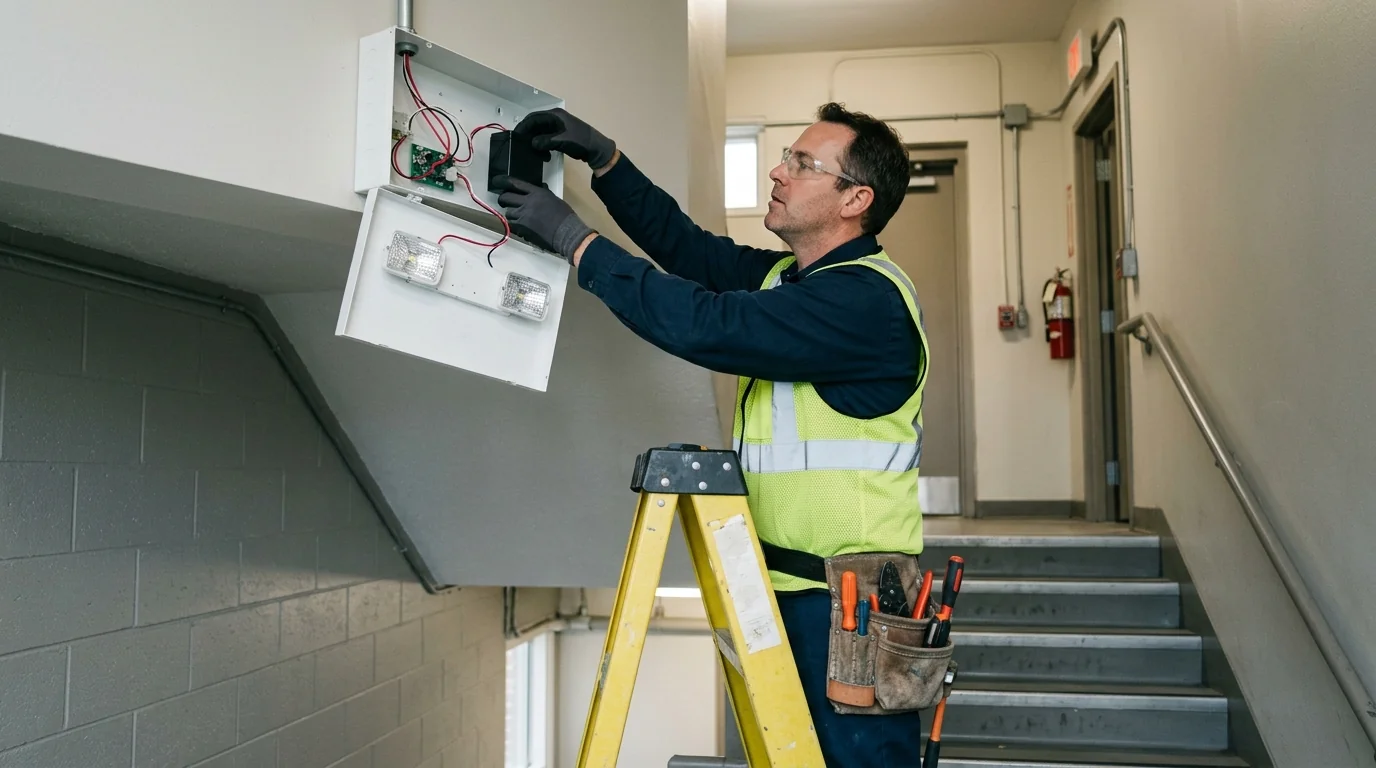
Battery-backed emergency lights have a test button that simulates a power loss. A quick press shows whether the lamps come on, but only a longer test on battery shows whether the battery can carry the lights for the full time the code expects. We run both kinds, note any unit that dims early or fails, and replace batteries or whole units as needed. Self-testing units that run their own checks and show a status light reduce the monthly work. The trade-off is cost per unit against labor, since manual testing in a large building takes real time every month.
Egress lighting layouts
Renovations, new partitions and moved doors change the path people walk to get out, and the emergency lighting does not move with it unless someone plans it. The result is a dark corner at a corridor turn, a stairwell landing with no light, or an exit sign pointing at a wall that used to be a door. We walk the path from the farthest room to each exit, note gaps, and add or move units so the route stays lit on battery. Larger buildings with a generator or central inverter take a different approach, with emergency circuits instead of individual battery units.
Exit signs failing their test? Call and we will test the whole building.
Call (617) 843-6591Emergency lighting problems you can spot
Exit sign dark or dim
A failed lamp, a dead battery or a sign on a switched circuit.
Lights do not come on when the test button is pressed
Battery or charger failure inside the unit.
Emergency lamps fade within minutes on test
The battery can no longer hold a full charge.
Charging indicator out or flashing
The unit has lost normal power or is reporting a fault.
Arrow points away from the current exit
A renovation changed the route but not the sign.
The code behind emergency lighting in Massachusetts
Exit signs and emergency lights sit on the ceiling for years doing nothing, so dead batteries go unnoticed until a test or a real outage. How those units are wired falls under the 2023 NEC as amended for Massachusetts, while the fire and building codes decide how often the units are tested. When we service a building, we push the test button on every unit, swap failed batteries and lamps, and hand the manager a list of what passed and what we replaced, which is what an inspector asks to see.
What emergency lighting work costs depends on
Emergency lighting is priced per unit and per visit. These move the number most.
- Number of units. Replacing or testing ten signs takes far less time than a full building.
- Unit type. Combination units, remote heads and self-testing units carry different prices.
- Wiring condition. Signs on a switched circuit or with no box need rewiring, not just a swap.
- Ceiling height and access. Warehouse heights or stair towers may need a lift.
- Testing scope. A quick functional check is short; a full-duration annual test takes hours.
- Layout changes. Adding units for a renovated floor means new circuits and new locations.
How a building gets tested and corrected
Inventory
We list every sign and battery unit by location and type.
Test on battery
Functional and duration tests to find units that fail or dim early.
Walk the egress path
From the farthest room to each exit, noting dark spots and wrong arrows.
Replace and correct
Failed units replaced, signs moved to unswitched circuits, gaps filled.
Record results
A written list of units tested, results and work done for your files.
What building staff can check themselves
Safe for a homeowner
- Press each test button monthly and note the result
- Walk the exit path with the lights off and look for dark spots
- Report units with a dark charging light
- Keep signs visible, not blocked by displays or stock
Leave to an electrician
- Replacing batteries or lamp heads inside units
- Moving signs to an unswitched circuit
- Adding units after a renovation
- Running full-duration annual tests across a building
If a unit fails its test, mark it and call. A failed unit is a problem in an outage, not just at inspection time.
Emergency and exit lighting questions
Fire and building codes generally call for a short functional test every month and a longer full-duration test once a year, with results recorded. Your fire inspector can tell you how they want records kept.
Not necessarily. A sign can stay lit on normal power with a dead battery. Only a test on battery power shows whether it will stay on in an outage.
Yes, pressing the test button and noting the result is a simple task. Replacing batteries, wiring or units is work for an electrician.
In buildings with many units they save monthly labor and flag failures automatically. In a small shop with a few units, manual testing is usually fine.
Often. New partitions and doors change the exit path. We walk it and add or move units so the route stays lit.
Yes. LED signs draw far less power and last longer, and we connect them to the correct unswitched circuit.