Updated October 2026
Straight answer
Intercom and doorbell wiring in Boston is mostly repair and upgrade work on old low-voltage systems: a buzzer that stopped ringing one unit, a door release that hums but will not open, or a video doorbell that keeps rebooting on a weak transformer. We find the failed transformer, wire or strike, and fix it or replace the system.
How a building intercom actually works
Most building intercoms are simple circuits: a transformer near the panel, a bundle of thin wire running to each unit station, a call button at the front door and an electric strike in the door frame. In a brownstone or rowhouse converted to condos, those runs were often added decades ago and spliced at every renovation since. When one unit stops ringing, the fault is usually a single broken splice or a corroded button, not the whole system.
Video doorbells raised the bar for the old wiring. A chime transformer that rang a bell for forty years often cannot keep a camera powered, and the doorbell drops off Wi-Fi or reboots when someone presses it. Door releases have the same weakness, because a long, thin run loses voltage before it reaches the strike. We size the transformer to the device and fix the run so it holds.
Intercoms, video doorbells and door releases
Brownstone and multi-unit intercoms
In a building with three to six units, the intercom is shared and every owner notices when it fails. We test the transformer, the door panel and each unit station, then trace the run to the dead unit. Often we can reuse the old wire if it tests sound, which saves opening plaster on every floor. When the runs are too damaged or the stations are obsolete, the choice is between new wired stations, which need a new run up the building, and a system that rings phones over the internet, which needs good Wi-Fi at the door. Associations usually pick based on how many walls they are willing to open.
Video doorbell transformers
A video doorbell that reboots, loses Wi-Fi or chimes weakly is often short on power. Older chime transformers commonly put out 10 or 16 volts at a low rating, while many video doorbells call for a higher voltage and more current. We check the doorbell's requirement, replace the transformer with one that matches, and confirm the old chime will not overload or buzz. In some houses the transformer is mounted inside the panel or a basement ceiling and has to be moved to a proper box. The job is quick once the transformer is found; finding it in an old house is sometimes the slow part.
Door release wiring
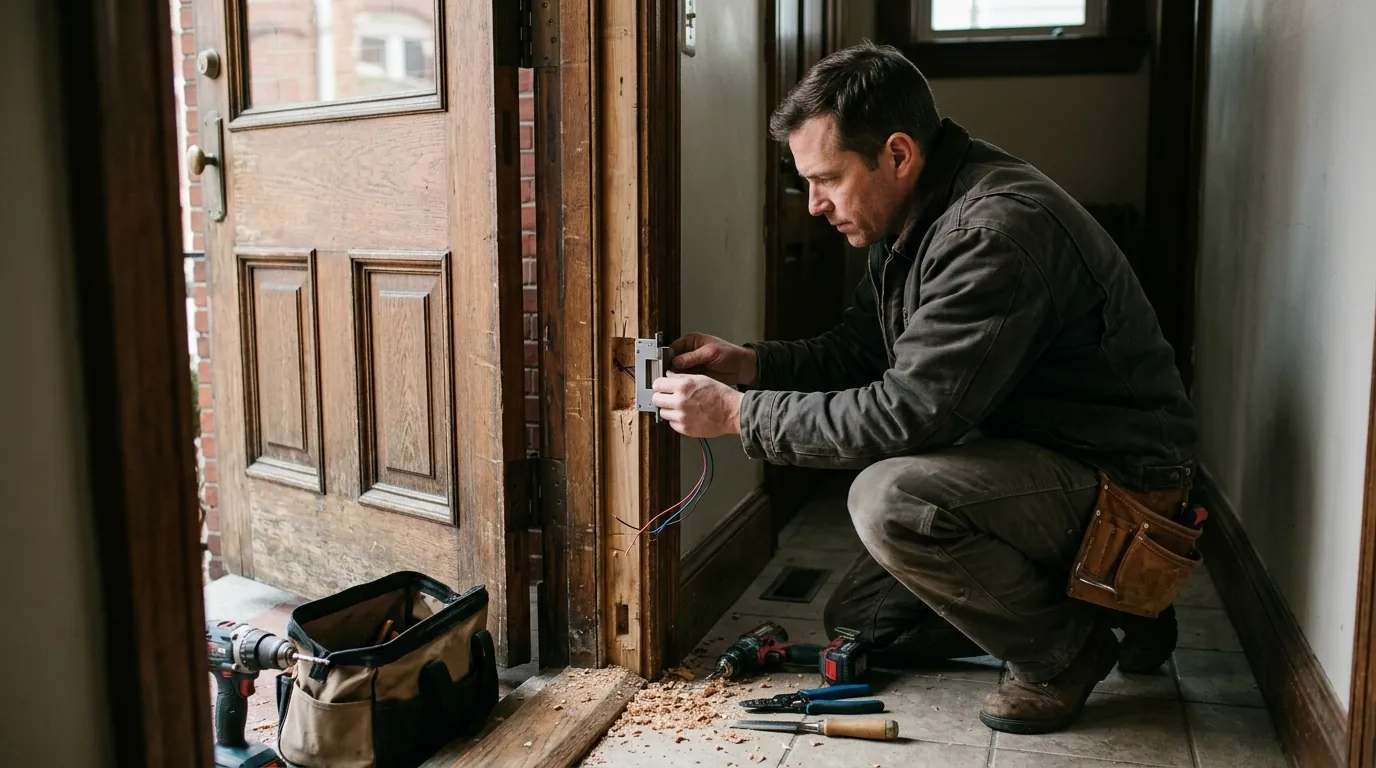
When residents press the release and hear a hum or click but the door stays locked, the electric strike is not getting enough power or has worn out. Long runs of thin wire lose voltage, and a strike rated for one voltage will not pull on another. We measure the voltage at the strike while the button is pressed, check the transformer and the run, and replace the strike or rewire it as needed. A strike also has to match the door hardware, so we look at the latch and frame before ordering, which avoids a second visit for a part that does not fit.
Front door will not buzz open? Call and we will trace it.
Call (617) 843-6591What decides the cost of intercom and doorbell work
Intercom and doorbell jobs range from a transformer swap to a new system for the whole building. These are the factors that decide where yours falls.
- Number of units. Each unit station adds testing and, on a new system, a new run.
- Condition of old runs. Wire that tests sound can be reused. Broken runs mean fishing new wire through plaster.
- System type. Wired stations and internet-based systems differ in equipment and labor.
- Door hardware. A strike that must be fitted to an old frame takes more time than a direct swap.
- Transformer location. A transformer hidden in a ceiling or panel may need to move to a proper box.
Buzzers in Boston brownstones and row houses
Buzzer systems in old row houses are usually the newest wiring in the building and also the least documented. In Back Bay, a brownstone split into several condos often shares one entry panel that was added long after the house went up. Charlestown has blocks of 1800s row houses with the same story: flats carved out over time and an intercom bolted on later. The low-voltage runs snake up through plaster and narrow stairwells, so we test each conductor from the door station to every unit before we decide whether to reuse the cable or go wireless.
How we find a dead buzzer
Test from the door
We check the call button, strike and transformer while someone presses each unit.
Trace the dead run
The faulty unit is traced back to the splice, station or broken wire.
Match the parts
Transformer, strike and stations are matched to the voltage and the door hardware.
Repair or replace
We fix the run or install new stations, keeping wall openings small.
Test every unit
Each unit rings and releases the door before we leave.
Doorbell fixes you can try and where to stop
Safe for a homeowner
- Replace a battery-powered chime or button
- Check the doorbell app for low-power warnings
- Clean corrosion from an outdoor button
- Note which units ring and which do not before calling
Leave to an electrician
- Replacing a transformer mounted in the panel
- Rewiring a shared building intercom
- Fitting an electric strike to the door frame
- Running new low-voltage wire through plaster walls
Doorbell wiring is low voltage, but the transformer that feeds it connects to a 120 volt circuit, so switch off that breaker before touching it.
Signs the intercom or doorbell is failing
Door release hums but will not unlatch
Low voltage at the strike or a worn strike.
One unit no longer rings
A broken splice or failed station on that unit's run.
Video doorbell drops off Wi-Fi when pressed
The transformer sags under load when the chime fires.
Chime buzzes constantly
A stuck button or a transformer failing internally.
Intercom and doorbell questions
Usually the transformer cannot supply enough power. Older chime transformers are often rated too low for a camera doorbell, and replacing it with a matched transformer fixes it.
Rarely. A single dead unit usually points to a broken splice, a corroded button or a failed station on that run. We trace that unit first before touching anything shared.
The strike is either not getting enough voltage or is worn out. We measure at the strike while the button is pressed to tell which.
If the wire tests sound and has enough conductors for the new stations, often yes. That avoids opening plaster walls on every floor of the building and keeps the job shorter.
Some transformers are mounted inside the main panel, which carries line voltage. If yours is there, or you are not sure which breaker feeds it, have an electrician do it.
Yes. Internet-based door stations work well where Wi-Fi reaches the front door, and they avoid new runs to each unit. Residents answer and release the door from a phone app.