Updated October 2026
Straight answer
A subpanel installation in Boston gives you more breaker spaces near the work, such as a garage, basement or addition, without changing the service size. It does not add capacity; the main panel still limits the total load. We check the load, size the feeder and its breaker, keep neutral and ground separate at the subpanel, and file the permit.
When a subpanel is the right answer
People usually call about a subpanel for one of two reasons. The main panel is out of spaces, or the new circuits are far from it, in a detached garage, an attic conversion or a back basement room. A subpanel solves both by putting a small panel near the loads, fed by one larger circuit from the main.
What a subpanel does not do is add capacity. If the main service is near its limit, a subpanel just spreads the same amps across more breakers. That is why we start with the load: what the new circuits will draw, what the house already draws, and whether the service can carry both without tripping the main.
Where subpanels earn their place
Basement and garage subpanels
A finished basement or a workshop is the classic subpanel job: a run of new lighting, outlet and dehumidifier circuits, all in one area, far from the main. An attached garage is similar. A detached garage adds rules: the feeder runs underground or overhead, the building needs its own disconnecting means, and it gets its own grounding electrode, with the equipment ground carried from the house. We choose the burial method and depth for the route and keep neutral and ground separate in the outbuilding panel. The trade-off is trenching versus capacity: a bigger feeder costs more now and saves a second trench later.
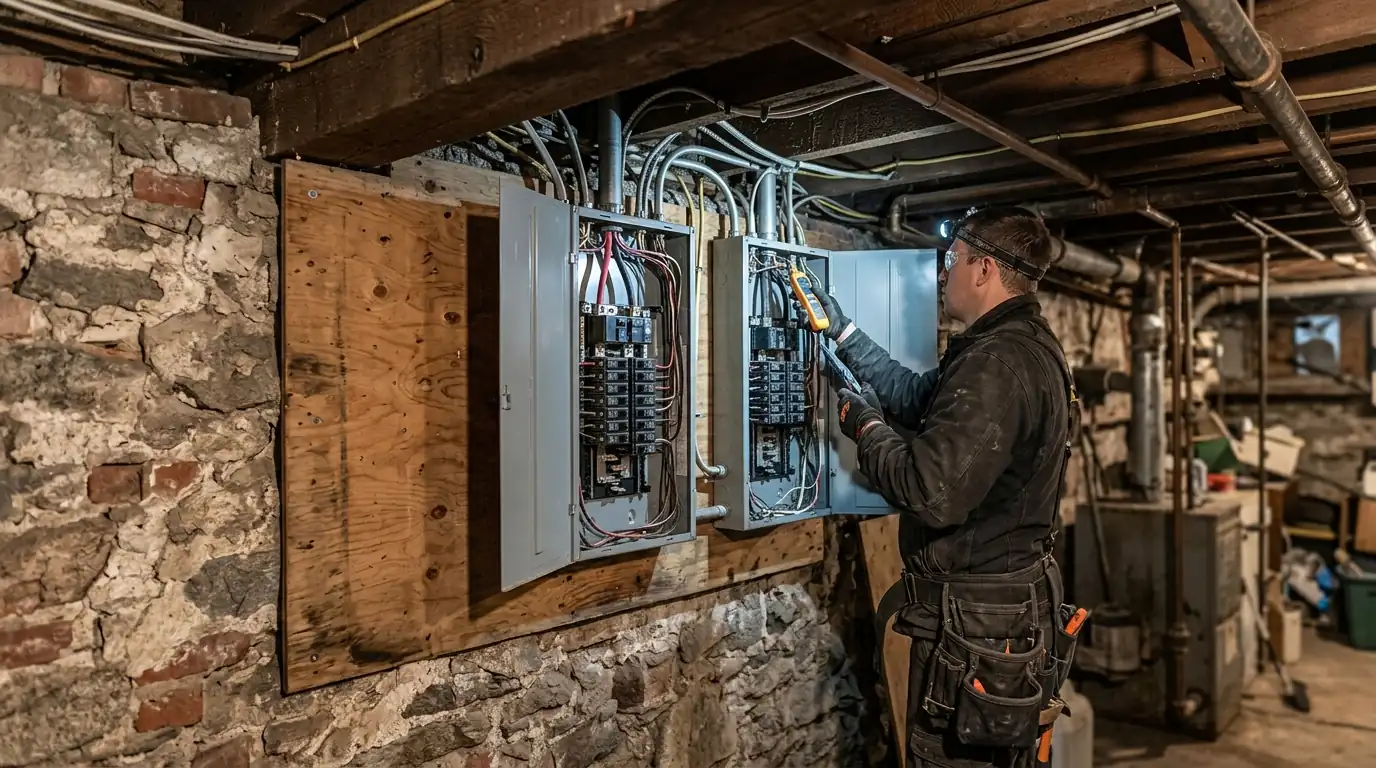
Unit subpanels in multi-family homes
In two and three family houses, each unit often has its own panel fed from that unit meter, and those panels are frequently undersized or located where tenants cannot reach them. Code expects occupants to have ready access to the breakers serving their unit, so a panel in a locked basement can be a problem. We replace or add unit panels, confirm each feeder actually comes from the meter it is labeled for, and correct crossed circuits where a bedroom light ends up on the neighbor panel. That last one matters the day someone switches off a breaker to work on a fixture.
Feeder sizing
The feeder is the cable or conduit run from a breaker in the main panel to the subpanel, and its size sets what the subpanel can deliver. We size it from the calculated load, the conductor ampacity tables and the length of the run, since long runs lose voltage and sometimes need a larger conductor than ampacity alone suggests. Aluminum feeder is common and acceptable at these sizes when terminated correctly. A typical subpanel gets four conductors: two hots, a neutral and an equipment ground, with the neutral bar isolated from the enclosure.
Out of breaker spaces? Call and we will check whether a subpanel will do.
Call (617) 843-6591What a subpanel job costs depends on
A subpanel is mostly a feeder job plus a small panel, so the run between the two drives the price.
- Feeder length and route. Crossing a finished basement or running underground to a garage takes far more time than a short run beside the main.
- Feeder size. A 100 amp feeder uses much heavier conductor than a 60 amp one.
- Trenching. Detached buildings need an underground run or an overhead span, each with its own work.
- Space in the main panel. If the main has no room for the feeder breaker, it may need rearranging or replacing.
- Number of new circuits. The subpanel is the start; each circuit fed from it is its own line item.
Subpanel, new panel or service upgrade?
A subpanel is one of several ways to get more circuits, and the right one depends on how much capacity the service has left.
| Option | Adds breaker spaces | Adds capacity |
|---|---|---|
| Subpanel | Yes, near the new loads | No, it shares the main service |
| New larger main panel | Yes, at the main | Only if the service is upgraded too |
| Service upgrade with new panel | Yes | Yes, more amps to the house |
| Tandem breakers | A few, where the panel allows | No |
Subpanel rules under Massachusetts code
Heat pump projects are one of the most common reasons we add a subpanel in Boston houses. Mass Save offers incentives to homeowners who switch, but the qualifying details get rewritten each program year, so confirm the current terms before you commit to equipment. Once the system is chosen, the electrical side is straightforward. A subpanel near the outdoor units or air handlers gives the new circuits a home without crowding the main panel, as long as a load calculation done the way the electrical code lays it out shows the service can carry it.
What a subpanel install covers
- Load check against the existing service
- Feeder breaker in the main panel
- Feeder sized for the load and run length
- Subpanel with isolated neutral and a separate ground bar
- Grounding electrode for detached buildings
- Working clearance kept in front of the panel
- Labeled directory in both panels
- Permit and inspection
How we add a subpanel
Load check
We confirm the main service can carry the new circuits before planning the subpanel.
Location and route
We pick a spot with proper clearance and plan the feeder path through the house or yard.
Permit
We file the permit for the subpanel and feeder.
Install and terminate
Feeder pulled, subpanel mounted, neutral bar isolated, ground bar fastened to the enclosure.
Circuits and inspection
New circuits landed, tested and labeled, then inspected.
Subpanel questions
Only if the main service has spare capacity. A subpanel adds breaker spaces, not amps. A load calculation shows whether there is room, and if there is not, a load management device or a service upgrade is the real fix.
Not in a clothes closet, and not in a bathroom. It needs clear working space in front of it and has to be easy to reach. Utility rooms, basements and garage walls are the usual spots.
Neutral and ground are joined only once, at the main service. Joining them again at a subpanel lets normal current flow on ground wires and metal parts, which defeats the safety path they exist for.
Generally yes. A separate building gets its own grounding electrode, in addition to the equipment ground run with the feeder from the house.
Sometimes, if the panel is listed for tandems in those slots. Many older panels are already full of them, and that is usually a sign a subpanel or a new panel is the better path.