Updated October 2026
Straight answer
Home battery backup installation in Boston means mounting a battery and its gateway, then wiring it so the house disconnects from the grid in an outage and runs on stored power. A battery can pair with existing solar to recharge during the day, or charge from the grid as backup-only. What it powers depends on its output, not only its storage size.
Storage, output and what a battery can really run
A battery system has two numbers that matter. Storage, in kilowatt-hours, decides how long it can run your loads. Output, in kilowatts, decides how much it can run at once. Many homeowners buy for storage and are surprised when the battery cannot start the central air. We start with the loads you want covered, then size both numbers to fit.
The battery itself mounts in a garage, a basement or on an outside wall, depending on the model and its location rules. A gateway or backup switch isolates the house from the grid during an outage. That isolation is what lets a solar system keep producing when the grid is down instead of shutting off, and it keeps battery power off the utility lines.
Solar-paired, backup-only and the critical loads panel
Battery with existing solar
Most grid-tied solar systems shut down in an outage to protect lineworkers, so panels on the roof do nothing when you need them. Adding a battery with a gateway lets the house island from the grid and keep the solar running to recharge the battery. The battery is usually AC-coupled, meaning it connects on the AC side and works alongside your existing inverter. Some inverters and batteries pair better than others, so we check what is on the roof first. A battery added to a solar system also changes how the system ties to the grid, so it goes through the utility interconnection process before it runs.
Backup-only batteries
A battery with no solar charges from the grid and sits full, waiting for an outage. It works like a silent standby generator with a limited fuel tank: it covers a set amount of energy, then it is empty until the grid returns. For a short outage that is plenty. For a multi-day storm, you need to cut loads to stretch it. Backup-only systems have no exhaust, no fuel deliveries and almost no routine maintenance. They suit houses where a generator has nowhere to go, such as a tight city lot or a condo with no yard, where the association allows the install.
Critical loads panels
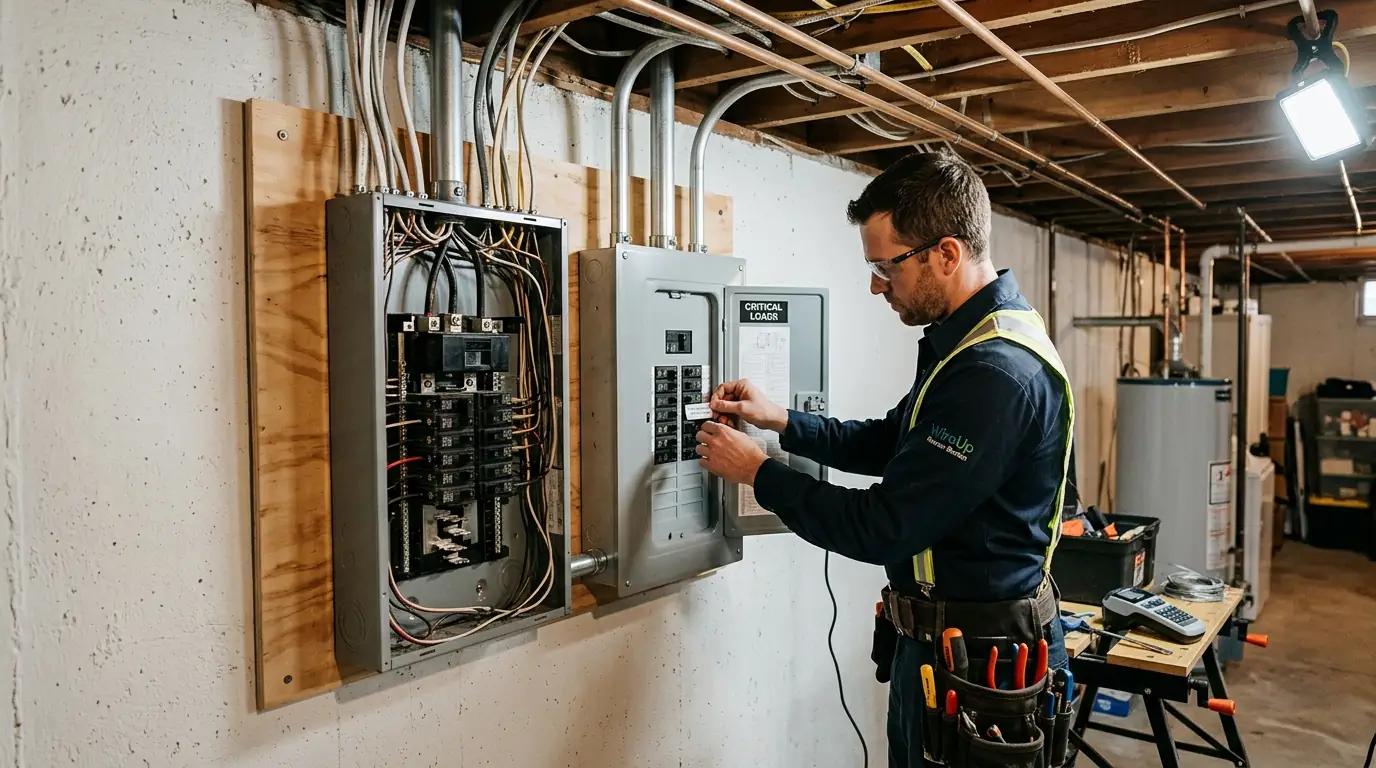
Instead of backing up the whole house, many battery installs move a set of circuits into a separate critical loads panel. The battery feeds only that panel: refrigerator, furnace or boiler controls, sump pump, some lights, outlets and the internet router. Keeping big loads like central air, a range or an EV charger off the panel stretches the battery further. The trade-off is a fixed list. If you later want a circuit on backup, it has to be moved. We plan the list with you before the install, then relocate those circuits and label both panels so it is obvious what runs in an outage.
Want backup power without fuel or noise? Call and we will size a battery.
Call (617) 843-6591What decides the cost of a home battery install
A battery job is priced on the equipment, how much of the house it covers and how it ties into what is already there.
- Storage and output. More kilowatt-hours and more continuous output mean more or larger battery units.
- Whole home or critical loads. A critical loads panel adds a subpanel and circuit moves. Whole-home backup needs more output.
- Existing solar. Pairing with an older inverter can need extra equipment or settings changes.
- Mounting location. Distance between battery, gateway and panel sets wire and conduit length.
- Panel condition. A full or outdated panel may need work before the gateway can go in.
- Permits and interconnection. Electrical permits and the utility process for solar-tied systems take filings and time.
Which battery setup fits your house
The right battery setup depends on whether you have solar and how much of the house you want covered.
| Setup | Recharges in an outage | Typical coverage |
|---|---|---|
| Battery with existing solar | Yes, from the roof in daylight | Critical loads or whole home |
| Backup-only battery | No, waits for the grid | Critical loads for a short outage |
| Battery plus generator | Yes, from the generator | Longer outages with less fuel use |
Planning a battery for multi-day outages
Boston winters are hard on a battery plan. A winter outage asks for heat, and an all-electric house draws a lot of it, while a battery mounted in an unheated garage gives up some output in deep cold. Many homes here also have panels that grew piece by piece over decades, with circuits for an addition or a basement apartment mixed in, so picking the critical loads takes a careful walk through the panel. We list what you truly need running, size the storage and inverter for that list, and move those circuits to a backup panel so the battery is not trying to carry the whole house.
How long a battery install takes
Mounting the battery and gateway and moving circuits to a critical loads panel usually takes one to two days on site. The longer part is often paperwork: permits, and for systems tied to solar, the utility interconnection process before the system can run as designed.
How a battery install comes together
List the loads you need
We pick the circuits that must run in an outage and add up their draw.
Size storage and output
Battery count and output set against those loads and the outage length you plan for.
Check solar and panel
Inverter compatibility, panel condition and where the gateway can mount.
Install battery, gateway and panel
Battery mounted, gateway wired, critical circuits moved and labeled.
Test islanding
We cut the grid at the main and confirm the house runs on the battery.
Home battery questions
It depends on what is running. A battery on a critical loads panel can last much longer than one asked to carry the whole house, and solar recharges it on sunny days.
Usually yes, often with an AC-coupled battery that works alongside the inverter you have. We check the inverter and panel first, since some pairings need extra equipment or settings changes.
No. A backup-only battery charges from the grid and sits full for outages. It will not recharge until power returns, so a long storm means rationing what runs.
Sometimes, with enough output and storage. Most critical loads setups leave those off on purpose, because a few hours of central air can drain what would otherwise run the fridge for a day.
A generator runs as long as it has fuel. A battery is silent and fuel-free but limited by storage, unless solar recharges it. Some houses pair both for long outages.
Garage, basement or an outside wall, depending on the model and its location rules. We check those on the site visit, along with the distance to the main panel.