Updated October 2026
Straight answer
Fuse box replacement in Boston usually means retiring a 60 amp fuse panel and installing a breaker panel, often with a larger service at the same time. A correctly sized fuse protects fine. The trouble is the 30 amp fuse screwed into a 15 amp circuit. We replace the panel, size every breaker to its wire, and update the service and grounding.
What is actually wrong with a fuse box
A fuse protects a circuit by melting a thin strip when current runs too high. Sized correctly, it does the job well. The problem with fuse panels is the human part: when a 15 amp fuse keeps blowing, someone eventually screws in a 20 or a 30, and now the wire in the wall can overheat before the fuse ever opens. We find that often enough that we check every fuse against its wire.
Fuse panels also tend to come with small services, often 60 amps, and very few circuits for a modern kitchen. Insurers and home buyers notice them too. Replacing one gives you breakers you can reset, room for new circuits and a clean starting point for AFCI and GFCI protection.
Fuse panels we replace
Screw-in fuse panels
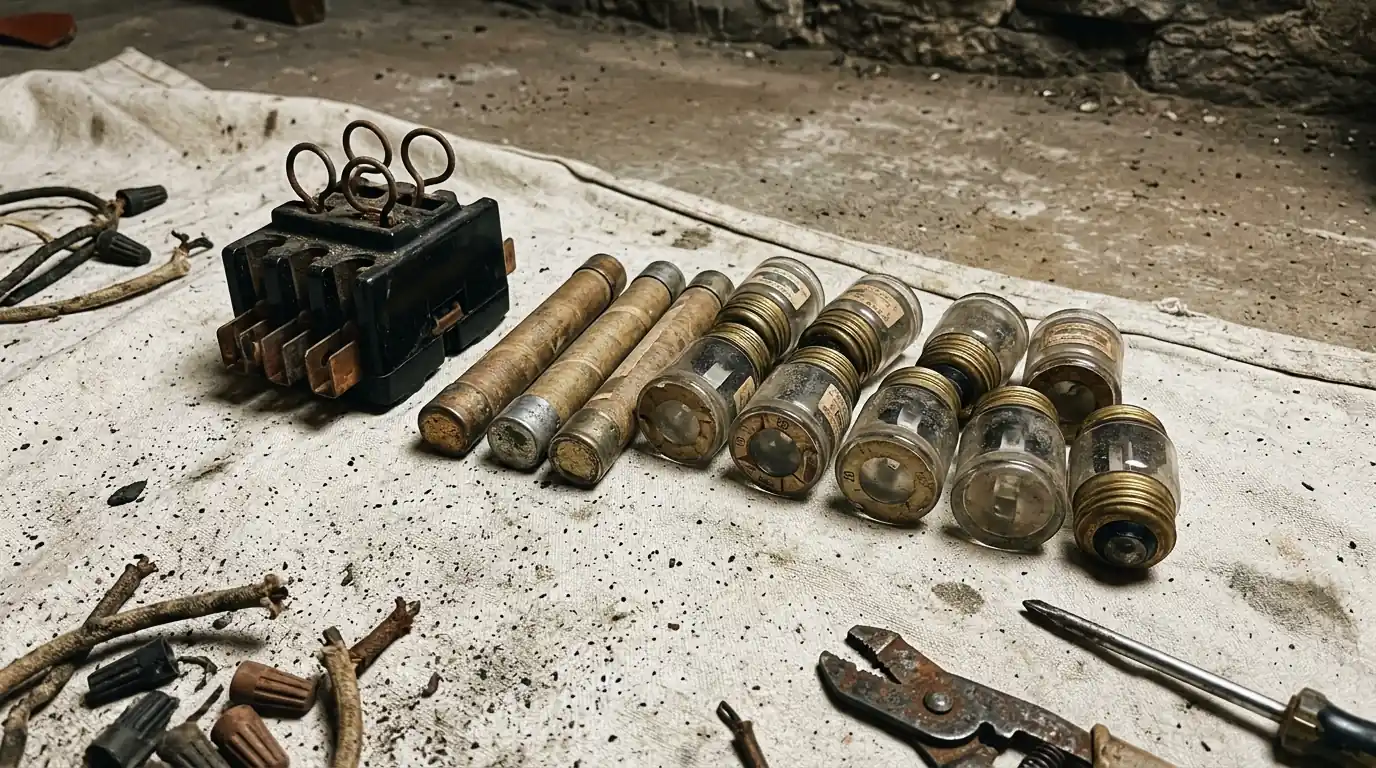
Screw-in, or plug, fuses with an Edison base are the familiar round glass ones. Any Edison base fuse fits any socket, and that is exactly how overfusing happens. A stopgap is a Type S adapter, which locks a socket to one fuse size, but it keeps the old panel and its small capacity. We usually recommend replacing the panel with a breaker panel, landing each circuit on a breaker matched to its wire size, and repairing any circuit whose wiring is too damaged at the panel to reuse. The trade-off is a bigger job than adapters, in exchange for a panel you can add to.
Cartridge fuse mains
Many fuse boxes have a main pull-out block holding two cartridge fuses, plus a second block for the range or dryer. Pulling the block by its handle cuts power, and corroded clips or heat-darkened fuse ends tell us the connections have been running hot. The clips lose their grip with age, and the cartridges are sometimes replaced with the wrong rating. When we replace the box, those blocks give way to a main breaker and two-pole breakers for the large appliances, and we decide whether the service conductors feeding the old main are worth keeping.
Overfused circuits
Overfusing means the fuse is larger than the wire can safely carry, such as a 30 amp fuse on 14 gauge copper rated for 15 amps. The fuse stops being protection at all, because the wire overheats before the fuse blows. Signs include fuses that never blow despite heavy use, discolored fuse sockets and warm cords. We match each circuit to its wire, which can mean a circuit that used to carry the whole kitchen now trips. The real fix there is a new circuit, and we plan those at the same time as the panel.
Blowing fuses every week? Call and we will check every fuse against its wire.
Call (617) 843-6591What affects a fuse box replacement price
Fuse box replacements vary more than most panel jobs because of what turns up behind the old box.
- Service size. Few houses stay at 60 amps; most fuse replacements move to 100 or 200 amps with new service equipment.
- Wire condition at the panel. Brittle cloth-covered wire near the box may need splicing in a junction box or a short new run.
- Circuits that need splitting. Overfused circuits often have to become two circuits to carry the load they were serving.
- Meter socket and mast. Old sockets sized for small services usually get replaced at the same time.
- Grounding. Fuse-era services often rely only on a water pipe and need ground rods added.
Older Massachusetts houses and fuse panels
Fuse panels hold on longest in Boston houses where nobody has opened the walls in a long time. We still find them in basements next to the boiler, sometimes with a newer breaker panel added beside them to feed a kitchen. The common trouble is predictable: oversized fuses screwed in to stop nuisance blowing, cloth-insulated wire gone brittle near the box, and a damp cellar that has rusted the enclosure. Replacing the fuse box usually means rebuilding that whole corner of the basement, so we plan the new panel location, grounding and circuit labeling together.
Included when we replace a fuse box
- Fuse-by-fuse check of wire size and condition
- Breaker panel with a main breaker
- Breakers sized to each circuit wire
- Splitting of overloaded circuits where planned
- Service equipment updated when the size changes
- Grounding electrode and bonding brought up to date
- Labeled circuit directory
- Permit and inspection
Taking a fuse box out of service
Check every fuse against its wire
We read the wire gauge on each circuit and note any fuse that is too large.
Plan service and circuits
We settle the service size and which overloaded circuits need splitting.
Permit and shutdown
Permit filed, and the utility disconnect scheduled if the service is changing.
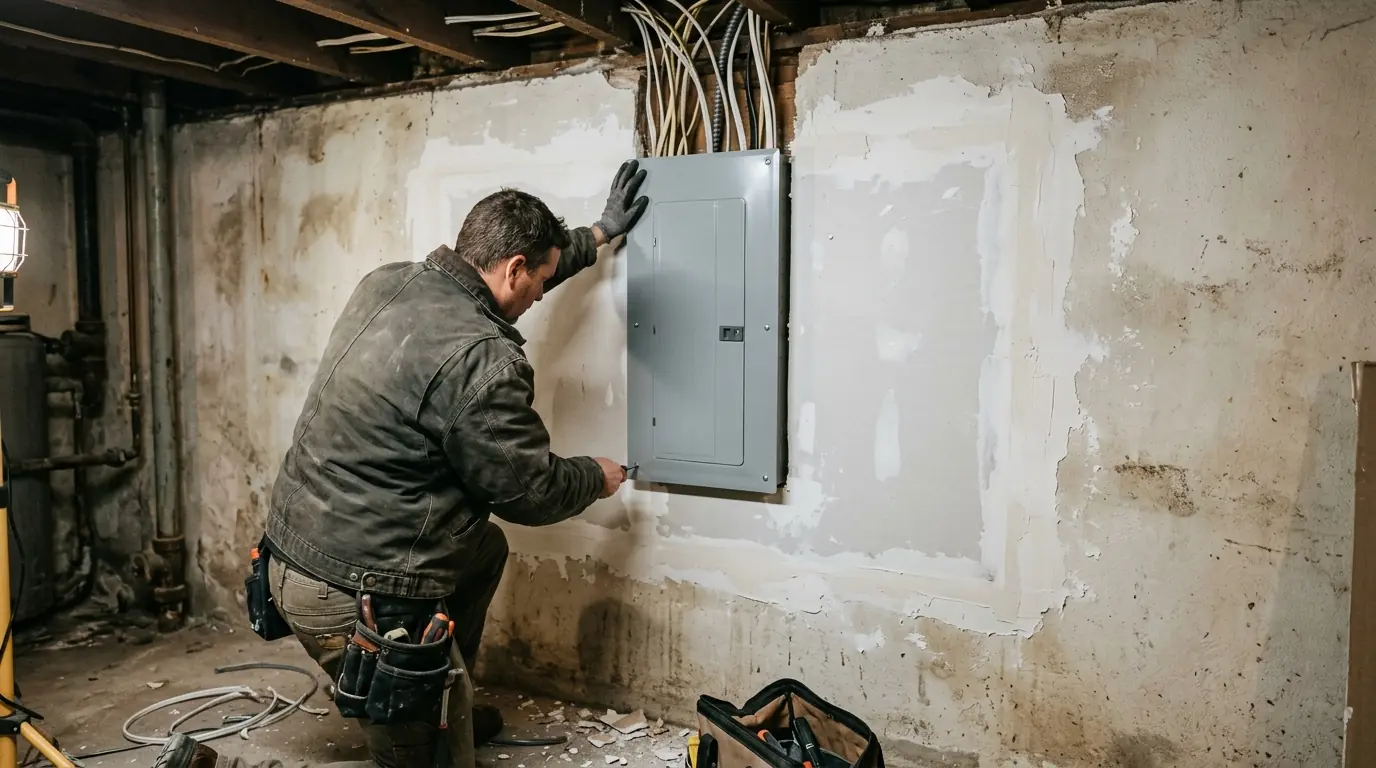
Replace the box
Fuse box out, breaker panel in, circuits landed on correctly sized breakers.
Test, label and inspect
Each circuit tested under load, the directory written, the inspection completed.
Fuse box tasks you can and cannot do
Safe for a homeowner
- Replace a blown plug fuse with the same rating
- Note which fuse controls each room
- Keep spare fuses of the correct rating on hand
- Unplug heavy loads from a circuit that keeps blowing
Leave to an electrician
- Pulling or servicing the main cartridge block
- Installing Type S adapters or changing any fuse rating
- Anything inside the fuse box beyond the fuse itself
- Replacing the panel or service equipment
Never replace a fuse with a larger one to stop it blowing; that removes the protection the wire depends on.
Signs the fuse box is working too hard
Fuses that blow when two appliances run
The circuit is carrying more than its wire can handle.
25 or 30 amp fuses on general outlets
Almost always oversized for the wire behind them.
Darkened or warm fuse sockets
Heat at the socket from a loose or overloaded connection.
Extension cords run to reach working outlets
A sign the house has too few circuits for how you live in it.
Fuse box replacement questions
A correctly sized fuse protects a circuit well. The difference is that fuses are easy to replace with the wrong size, and old panels rarely have room for new circuits or the AFCI and GFCI protection current code expects.
Putting in the correct size fuse for the wire is a reasonable step, as long as you know the wire gauge. If the right size fuse then blows constantly, the circuit is overloaded and needs an electrician, not a bigger fuse.
Some insurers and lenders ask about fuse panels, and buyers often negotiate over them. Requirements vary by company, so ask them directly, but expect the question to come up during a sale.
Not necessarily. Many fuse-era circuits are fine to keep and simply move to breakers. Knob and tube or badly damaged wire is a separate decision, and we tell you what we see at the panel.
It is an old shortcut where a coin was placed in the socket behind a blown fuse to bypass it. It removes all protection from that circuit. If you find one, leave that circuit off and call.