Updated October 2026
Straight answer
Dimmer and smart switch installation in Boston usually turns on two questions: is the dimmer rated for LED loads, and does the switch box have a neutral wire. Many older homes have switch loops with no neutral, which rules out most smart switches. We check the box, then pick a no-neutral model, run a neutral or use a different control.
Why a switch swap is not always quick
Changing a switch looks like a ten minute job, and with a plain toggle it often is. Dimmers and smart switches add two complications. LED bulbs and fixtures draw so little power that many older dimmers cannot control them smoothly, which shows up as flicker, buzz, or lights that will not turn fully off. Smart switches need a little power of their own to keep their radio running, and in most designs that power comes through a neutral wire.
So we start by opening the box and testing what is in it, and by checking the bulbs or fixtures on the circuit. Then we recommend a device that matches both, rather than the one that happened to be on sale.
LED dimmers, missing neutrals and multi-way switches
LED-compatible dimmers
Flicker at low settings, a hum from the switch, lights that glow faintly when off, or a dimmer that only works over half its slider are all signs the dimmer was designed for incandescent bulbs. LED-compatible dimmers are built for low loads and most have a trim adjustment that sets the lowest and highest output, which fixes most flicker. Dimmers also have a total load rating, and several on one box in a multi-gang plate lose capacity because of the heat they share. Mixed bulb brands on one dimmer can dim unevenly, so we suggest one bulb model per circuit. We check the bulb or fixture compatibility list before choosing a dimmer.
Smart switches without a neutral
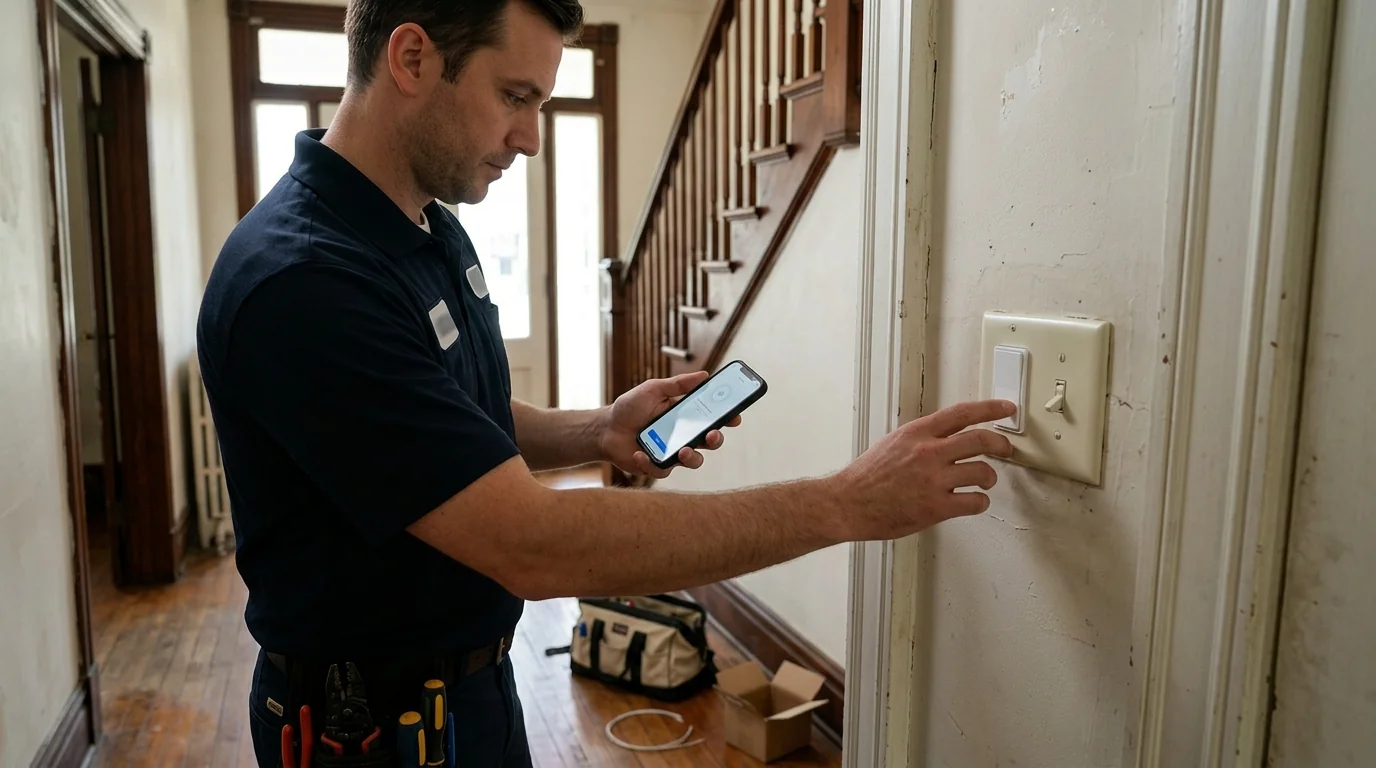
In many older homes the power runs to the ceiling light first and only a switch loop drops to the wall, so the switch box holds a hot and a switched leg with no neutral. Most smart switches need that neutral. There are three ways around it. Some smart dimmers are made to work without a neutral, drawing a trickle through the bulbs, which can make low-wattage LEDs glow or flicker. We can fish a new cable with a neutral from the light to the switch, often through the same wall cavity. Or a battery-powered remote switch can sit on the wall while a module at the fixture does the switching. We tell you which fits your box before you buy anything.
Multi-way smart controls
Stairways, long halls and rooms with two doors usually have three-way or four-way switching, and each traveler wire has to be identified before a smart switch goes in. Most smart systems use one main switch wired to the light and companion switches at the other locations, which talk to the main through a traveler or wirelessly. Mixing a smart main with old mechanical three-way switches does not work. Old multi-way circuits are also where we find the most miswiring, such as a neutral used as a traveler or splices hidden in the wrong box, so we trace the circuit before swapping devices. The result is a light that answers the same way from every switch and from the app.
LEDs flickering or a smart switch that will not fit? We will check the box.
Call (617) 843-6591What decides the cost of new dimmers and smart switches
Swapping one switch for one dimmer is a short job. These are the things that add time and parts.
- Neutral available or not. A box with no neutral may need new cable fished from the fixture.
- Box size. Shallow old boxes may need replacing to fit a smart dimmer and its wires safely.
- Multi-way circuits. Three-way and four-way setups need tracing and a companion switch at each location.
- Number of switches. Whole-house smart setups take time per device plus setup in the app.
- Ganged boxes. Several dimmers in one box may need higher-rated models or the side fins removed.
- Existing miswiring. Old circuits that were wired wrong have to be corrected before a smart device works.
Smart switch options when there is no neutral
When the switch box has no neutral, there are three workable paths.
| Option | How it works | Trade-off |
|---|---|---|
| No-neutral smart dimmer | Draws a trickle through the light | Some low-wattage LEDs glow or flicker |
| Run a new neutral | New cable from the fixture to the switch | Wall fishing and some patching |
| Remote plus fixture module | Battery switch on the wall, module at the light | Battery to replace, module needs room |
Old switch loops in Boston walls
Smart switches assume a newer wall than most Boston homes have. Houses here have gone through decades of additions and partial rewires, so one room may have a modern box with a neutral while the hallway next to it still has a two-wire switch loop and a shallow metal box packed behind plaster. We open the box first, confirm what is there, and then recommend a switch that works with it, whether that means a no-neutral model, a deeper box or a short new run. Dimmers also need to suit the LED bulbs you plan to keep.
How we match a switch to your lights
Check the lights
Bulb or fixture type and wattage noted and compared to dimmer compatibility lists.
Open and test the box
Neutral presence, box depth, wire condition and multi-way travelers confirmed.
Pick the device
Dimmer, no-neutral smart switch, new neutral run or remote option recommended.
Install and connect
Devices wired, box replaced if too shallow, companions installed at other locations.
Tune and pair
Low and high trim set to stop flicker, smart devices paired and tested from every switch.
What you can sort out yourself
Safe for a homeowner
- Check bulbs are labeled dimmable before blaming the switch
- Use one bulb model on each dimmed circuit
- Set up schedules and scenes in the app once switches are in
Leave to an electrician
- Any switch box with no neutral
- Three-way and four-way smart conversions
- Several dimmers ganged in one box
- Boxes with cloth wire or scorched insulation
If you open a switch box and find a white wire on the switch itself, it is probably being used as a hot conductor in a switch loop. Do not treat it as a neutral.
Dimmer and smart switch questions
Usually the dimmer was made for incandescent bulbs or the bulbs are not rated as dimmable. An LED-compatible dimmer with its low end trimmed correctly fixes most flicker.
A neutral is usually a bundle of white wires tied together at the back of the box. Many older switch boxes have only two wires and no bundle. We test to be sure.
Some smart dimmers are designed for it. They work well with many LEDs but can make very low-wattage bulbs glow. Otherwise we run a neutral or use a remote and fixture module.
Yes, with a smart main switch and a matching companion at the other location. Old mechanical three-way switches cannot stay in that circuit.
Dimmers shed some heat and feel warm in normal use. One that is hot to the touch is overloaded or failing and should be checked.
No. Fan motors need a fan speed control. A light dimmer on a fan can make the motor hum and overheat.