Updated October 2026
Straight answer
Restaurant electrical work in Boston covers the circuits behind the line: dedicated power for fryers, ovens and dish machines, the hood fans and controls, walk-in cooler and freezer feeds, and GFCI protection near sinks. Most kitchen problems trace to equipment added onto circuits never planned for it, and they show up as trips during service.
Kitchen electrical problems you can see
Breakers trip during service
A circuit is overloaded or a connection is failing under heat.
Receptacles discolored or melted
Heat at a plug from a loose contact or an oversized load.
Walk-in running warm with fans quiet
Power lost to the evaporator or condensing unit.
Hood lights on but fans dead
A failed fan circuit, contactor or interlock.
GFCI outlets tripping near the dish area
Moisture in a box or a cord, or a leaking appliance.
How we wire around your service hours
Equipment list first
We collect nameplate data for every piece on the line and in back.
Check the panel
Capacity, condition and directory accuracy, before adding circuits.
Plan the downtime
Shutdowns scheduled before open or after close, never mid-service.
Wire and test under load
Circuits installed, then each unit run while we measure current.
Label and walk through
Panel directory updated and the manager shown which breaker feeds what.
Why kitchen wiring fails during service
Kitchens are hard on wiring. Heat, grease, moisture and constant cleaning wear out cords, receptacles and boxes faster than anywhere else in a building. Equipment gets moved and swapped, and a new combi oven or a second fryer ends up on a circuit sized for something smaller. The result is a breaker that holds all morning and trips at the busiest hour.
We work two ways. Planned work, such as wiring a new line or a full kitchen, happens before opening or after close. Breakdowns, such as a dead walk-in or a hood fan that stopped, are handled as calls that cannot wait. Either way we check the nameplate of each piece of equipment against the circuit feeding it, because that comparison finds most problems.
Line, hood, cooler and inspection work
Kitchen equipment circuits
Commercial cooking equipment arrives with a nameplate that lists the voltage, phase and current it needs, and many pieces need 208 or 240 volt circuits of their own. Problems start when a unit is swapped for a bigger one without changing the circuit, or when a cord-and-plug item is fed through an adapter. We match each circuit to the equipment, install the correct receptacle or a hardwired connection, and provide GFCI protection where the code calls for it near sinks and wet areas. The trade-off is downtime: a new circuit to the line usually means a short shutdown, which we schedule outside service.
Hood and walk-in cooler power
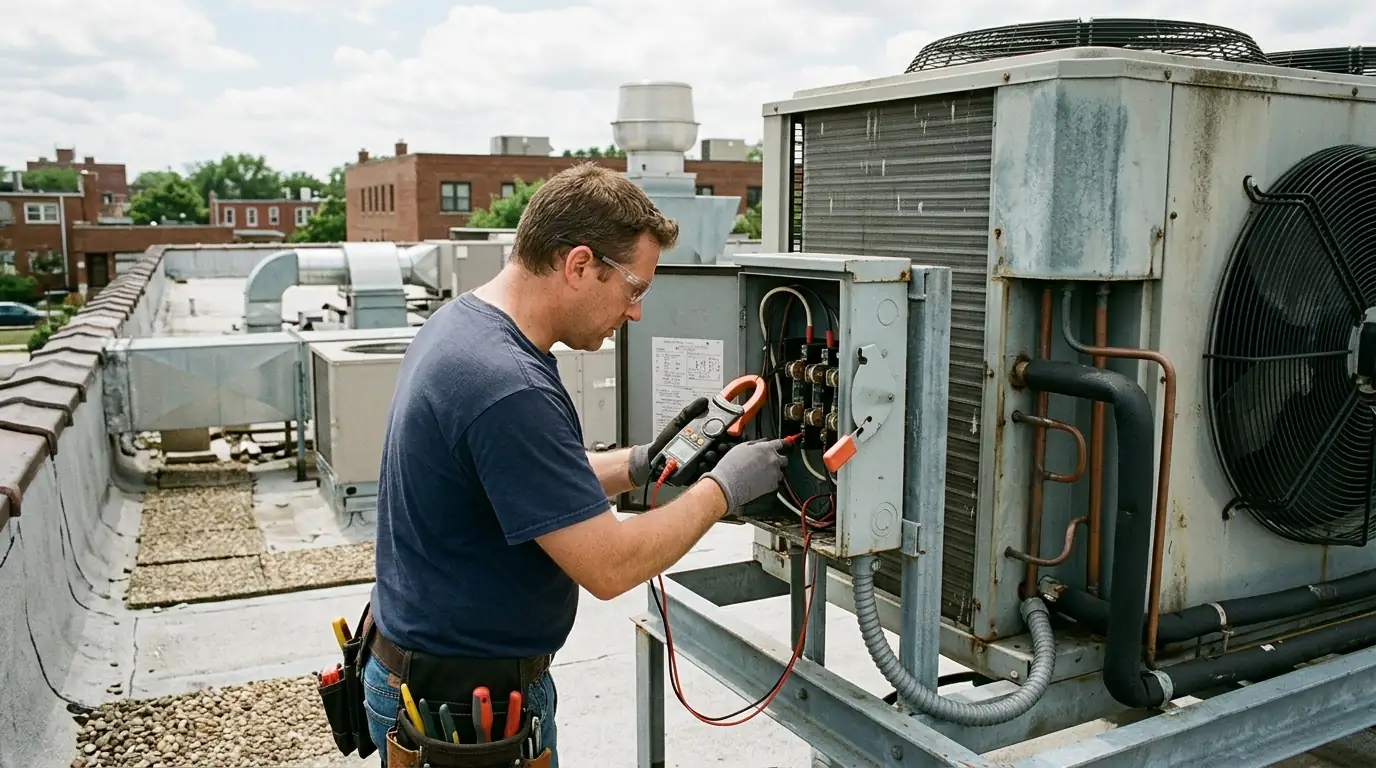
Hood exhaust and makeup air fans, the hood lights and the fire suppression interlock all depend on the electrical side working correctly. When the suppression system trips, it is designed to shut off cooking equipment under the hood, so its wiring to shunt trips or contactors has to be right. Walk-in coolers and freezers need dedicated circuits for the condensing unit and the evaporator, and a failure here puts the whole inventory at risk overnight. We trace the power from the panel to each component, test under load, and find whether the fault is electrical or mechanical before parts are ordered.
Code corrections before opening
Before a restaurant opens, inspection items tend to cluster around the same things: missing GFCI protection, receptacles in the wrong place, open junction boxes above the ceiling, panel directories that are blank, and equipment fed by extension cords. If a previous restaurant occupied the space, its leftover wiring may not match the new kitchen at all. We walk the space against the code and the equipment plan, correct what is wrong, and remove abandoned circuits. Doing this early matters, because a correction found at the final inspection pushes the opening date.
Walk-in down or breakers tripping on the line? Call us now.
Call (617) 843-6591The code a Boston kitchen is inspected against
Restaurant spaces in Boston are often older storefronts that have held several different businesses, each one leaving circuits behind. Behind the line we regularly find abandoned feeds, receptacles reused for equipment they were never sized for, and junction boxes buried above a drop ceiling. Grease, steam and a damp dish area are hard on all of it, and a basement prep kitchen can add moisture from below. We trace each piece of equipment back to its breaker, label the panel so the closing manager knows what is what, and rebuild the circuits that keep tripping during the dinner rush.
What a restaurant electrical job covers
- Nameplate review of each piece of kitchen equipment
- Dedicated circuits and correct receptacles or hardwired connections
- GFCI protection near sinks and wet areas
- Power and interlock wiring for hood fans and suppression
- Walk-in cooler and freezer circuits tested under load
- Removal of abandoned circuits from earlier tenants
- Panel directory rewritten for the kitchen
- Permit and inspection on work that needs it
What restaurant electrical work costs depends on
Restaurant electrical work is priced on the equipment, the panel and the hours you need us to work. These move it most.
- Equipment loads. Each dedicated 208 or 240 volt circuit to the line adds wire, breaker and labor.
- Panel capacity. A full panel or an undersized service means a new panel or feeder before anything else.
- Hood and suppression tie-ins. Interlocks, shunt trips and fan controls take coordination with the hood installer.
- Condition of existing wiring. Grease, heat and old tenant work often mean replacing rather than reusing.
- Working hours. Overnight and early-morning work around service costs more than daytime.
- Emergency response. A dead walk-in or a hood failure on a weekend night is priced as an emergency call.
Restaurant electrical questions
Usually the circuit is carrying more than one heavy load, or a connection is overheating once everything is running. We measure current with the line at full use to find which.
Yes. Call and we will check the power to the condensing unit and evaporator. If the fault is mechanical, we tell you so you can call refrigeration.
Kitchen equipment on extension cords is a common inspection failure and a real fire risk. A proper receptacle or a hardwired connection is the fix.
The hood and suppression system are installed by their own trades. We provide the power, fan circuits and interlock wiring that connect them.
Some of it, often. We check each circuit against your equipment list, then reuse what fits and remove what is abandoned.
Yes. Most restaurant work is scheduled before opening or after close.