Updated October 2026
Straight answer
An emergency electrician in Boston is the right call when you smell burning plastic, see sparks, find a hot outlet or lose power to part of the house while neighbors still have lights. Switch off the affected breaker, keep people away from the spot, and call. We answer any hour and send an electrician to isolate and repair the fault.
Signs it is an emergency
A smell like hot plastic or fish
Insulation breaking down from heat, often inside a box or behind a plate.
Outlets warm to the touch
A connection is resisting current and turning it into heat.
Breaker trips the instant it is reset
A short or ground fault, not an overloaded circuit.
Lights brightening and dimming across rooms
Classic symptom of a loose neutral on the service.
What happens after you call
Call and triage
We ask what you see and smell, and walk you through switching off the right breaker.
Make it safe
The electrician isolates the circuit or the panel before opening anything.
Find the cause
Testing at the device, the panel and the service, not guessing at the nearest outlet.
Repair and price
You get the cost, then the repair, with damaged wire cut back to sound copper.
Test and explain
Circuits retested under load, and anything that needs later attention written down for you.
When an electrical problem cannot wait
Most electrical emergencies are not the dramatic kind. They are a kitchen outlet that went black and smells faintly of fish, a breaker that snaps off the moment you reset it, or a bedroom wall plate that feels warm. Each one means heat is building somewhere it should not, and heat in an old wall is how fires start.
The job on an emergency call is narrow on purpose. Make it safe, find the fault, fix what failed and leave the house with working, protected circuits. If the visit turns up a bigger problem, such as a panel that is past its life, you hear about it and decide later, with the power back on.
The emergencies we handle most
Partial power loss
Half the outlets dead while the lights still work usually points to a lost leg of your 240 volt service, a failed main connection or a loose neutral. A loose neutral is the dangerous one, because it can send the wrong voltage to whatever stays plugged in, so bulbs glow too bright on one side of the house and too dim on the other. We check the service at the meter and the panel, confirm whether the problem is on the utility side, and repair the connection on our side. If the utility needs to come out, we tell you exactly what to report.
Sparking or burning outlet
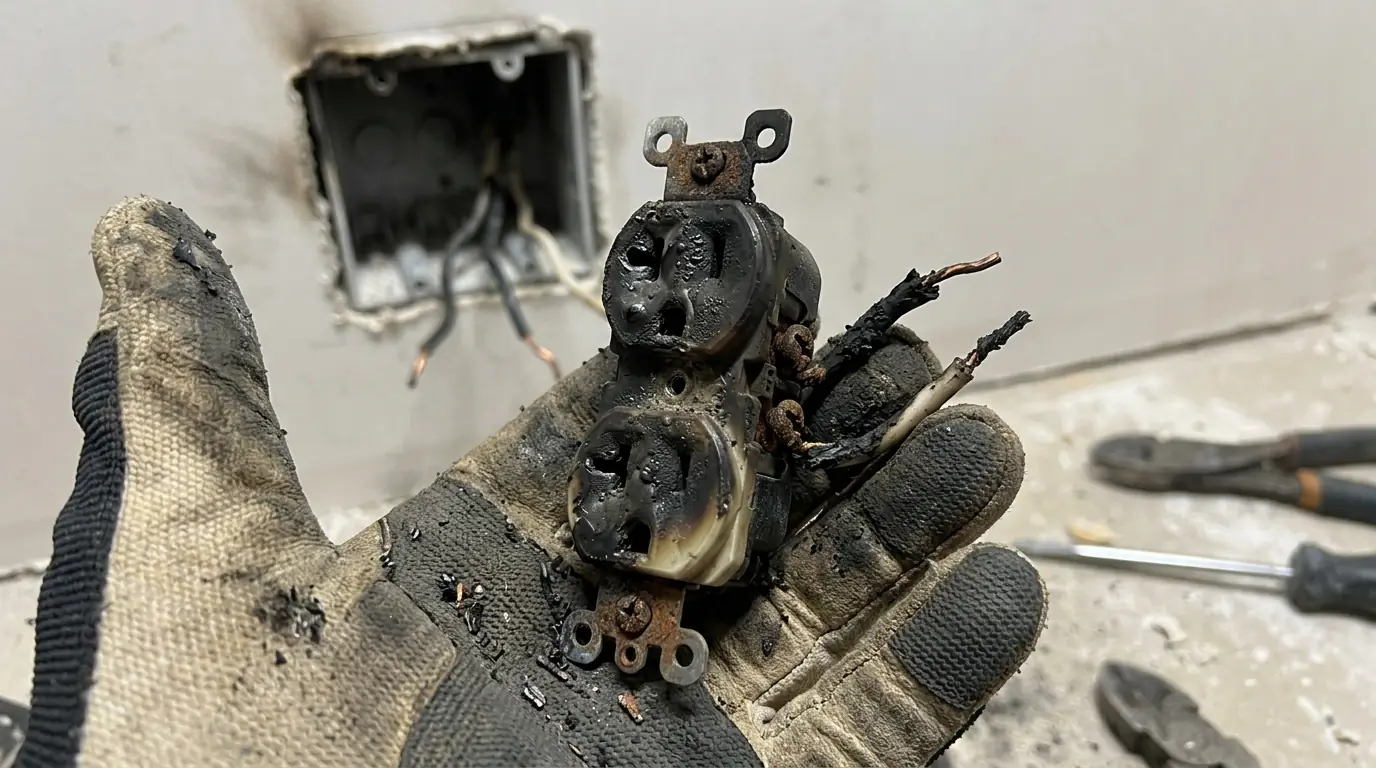
A device that sparked once and smells hot has almost always failed at a connection, often a backstabbed wire that loosened over years of plug cycling. We cut power to the circuit, open the box, and look at the wire itself, because heat travels and can damage the insulation several inches back. The outlet gets replaced, the conductors are trimmed back to clean copper, and we test the rest of the circuit so you are not chasing the same smell next month.
Water in a panel or fixture
Water reaching a panel, a ceiling fixture or a basement outlet is a stop-everything situation. Do not touch the panel if you are standing in water. From the phone we help you decide whether you can reach the main safely or whether the utility needs to cut service at the street. On site we dry, inspect and replace any breakers, devices or wire that got wet, since corrosion inside a breaker does not always show from the outside.
Service drop pulled down
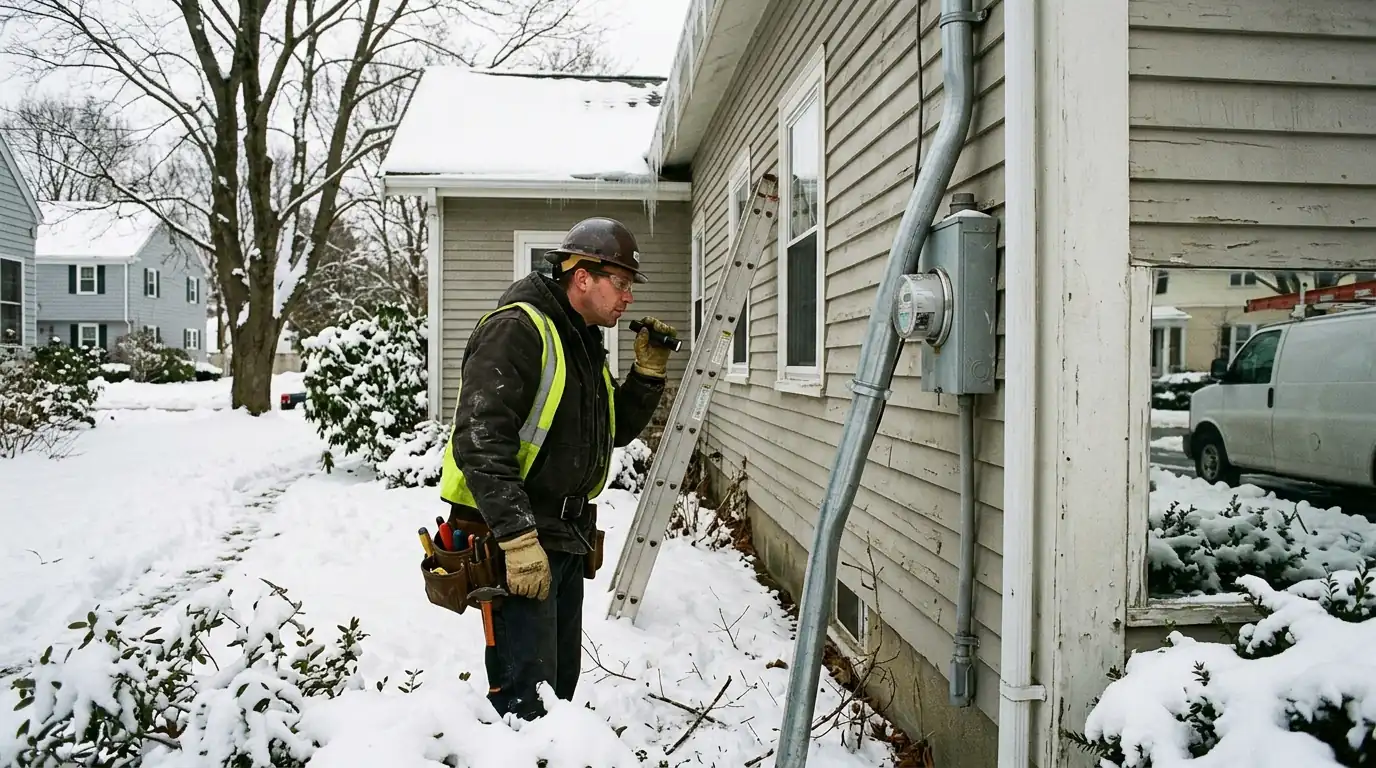
When a falling limb or ice load pulls the overhead line, it often bends the mast and tears the weatherhead or meter socket off the house. The utility reconnects the drop, but only to a mast and socket in good shape, which is your side of the job. We make the damaged equipment safe, rebuild the mast or socket, and coordinate the reconnect so the house is not left waiting on two different schedules.
Smell burning or see sparks? Switch off the breaker and call us now.
Call (617) 843-6591What to do before the electrician arrives
Safe for a homeowner
- Switch off the breaker for the affected circuit
- Unplug appliances on that circuit
- Turn off the main if you can reach it from a dry floor
- Call the utility if a line is down outside
Leave to an electrician
- Opening the panel or any outlet box
- Resetting a breaker that trips instantly
- Anything involving water near electrical equipment
- Repairs to the meter socket or service mast
If a line is down outside, stay well back from it and anything it touches, and call the utility before you call us.
Storm season and old walls
When a big coastal storm knocks out Eversource service across the state, outages can stretch past a day or two, and that is when our emergency calls stack up. The trouble rarely ends when the lines come back. A limb that tore the service drop can leave a bent mast, a generator fed through a dryer outlet can backfeed the street, and a basement that took water may have wet receptacles near the floor. In older Boston houses we also find splices hidden in plaster that gave out under the strain. We check what the storm actually touched before anything is switched back on.
How long an emergency visit takes
Most single-circuit emergencies are made safe and repaired in one visit of an hour or two. Storm damage to a mast or meter socket takes longer because the utility has to reconnect after our repair, and that part of the timing sits with them.
What decides the cost of an emergency visit
Every emergency call is priced on what the electrician finds, and you hear the cost before repair work starts. These are the things that move it most.
- Time of the call. Nights, weekends and holidays cost more than a weekday visit for the same repair.
- What failed. Replacing one device is a short job. A burned conductor inside a wall or a damaged breaker bus is not.
- Access. Finished basements, plaster ceilings and panels behind built-ins add time to reach the problem.
- Utility side work. Storm damage to a mast or meter socket means materials and coordination with the utility.
- Follow-up needed. Some fixes are temporary until parts arrive, which means a second visit.
Emergency electrician questions
Yes. Overheating wire insulation and plastic often smell fishy before there is any smoke. Switch off the circuit if you can identify it, and call.
No. A breaker that trips instantly is reacting to a short or a ground fault. Resetting it repeatedly forces current through the fault.
Often a failed leg of the service or a bad main connection. It can also be a utility problem, and we can tell which side it is on.
Yes. The phone is answered every day of the year, holidays included.
Keep the affected circuit off, do not use extension cords to work around it, and keep children and pets away from the area.
We repair the mast, socket or panel on your side and coordinate with the utility, which then reconnects the service.