Updated October 2026
Straight answer
A grounding and bonding upgrade in Boston usually means adding ground rods to a house that relies only on its water pipe, and bonding metal water and gas piping back to the service. Many older homes lost their only electrode when the metal water service was replaced with plastic. We test what is there, add what is missing, and tie it together at the panel.
Grounding and bonding are not the same job
Grounding and bonding are two jobs that are easy to confuse. Grounding connects the electrical system to the earth through electrodes, which helps with lightning and utility surges. Bonding connects every metal system in the house, like water pipe, gas pipe and panel enclosures, to each other and to the service, so a fault on any of them has a low-resistance path back that trips the breaker.
Older houses were often grounded to a cold water pipe and nothing else. That was accepted at the time. Today the code treats a metal water pipe as one electrode that must be supplemented by another, and decades of plumbing changes have broken many of those original connections without anyone noticing.
The grounding and bonding fixes we make
Ground rod and electrode work
The grounding electrode system can include metal underground water pipe, ground rods, a concrete-encased electrode in a newer foundation and other listed electrodes, all tied together. In an older house the practical fix is usually driving ground rods outside near the service, spaced apart, and running a grounding electrode conductor back to the panel or meter, protected where it could be damaged. A single rod has to pass a resistance test or get a second rod, and most electricians simply install two. Ledge and rocky fill can stop a rod short, which means driving it at an angle or laying it in a trench, both allowed methods.
Water pipe bonding
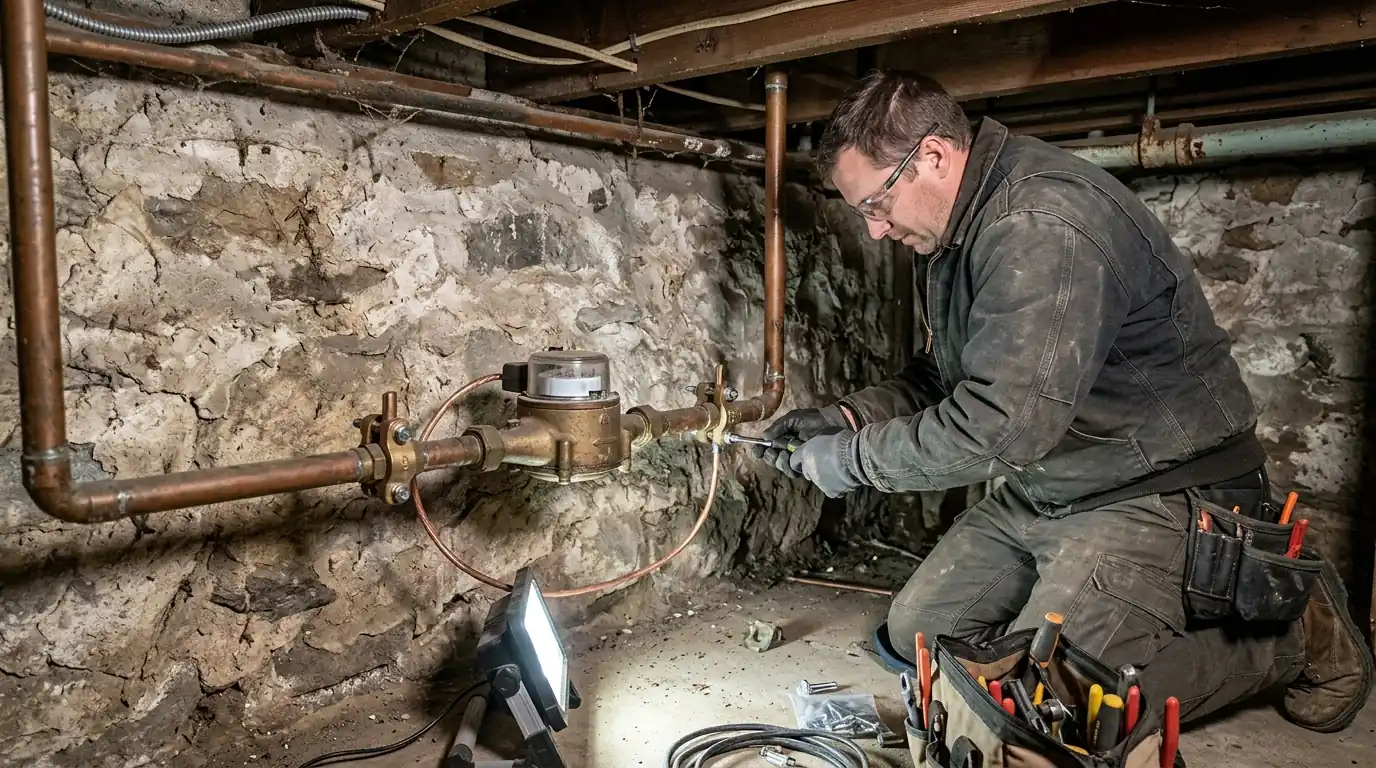
The metal water pipe inside the house needs a bond to the service, and that bond has to survive the water meter being pulled. That is why you see a jumper wire clamped on either side of the meter. When a plumber replaces the meter, a water heater or a section of pipe with plastic, the bond is often lost. We trace the grounding conductor, add a jumper around the meter, clamp to the pipe close to where it enters the building, and add bonding across any plastic section that splits the metal piping into separate runs.
Gas line bonding
Metal gas piping that could become energized needs a bond, usually through the equipment ground of the appliance circuit it serves. Corrugated stainless steel tubing, the flexible gas line usually wrapped in a yellow jacket, is the special case: most manufacturers call for a direct bond near where it enters the house, because a nearby lightning strike can arc through its thin wall. We follow the instructions for the CSST installed and run that bond back to the electrical service. A gas line is never used as a grounding electrode, only bonding to the system.
Got a tingle from a faucet? Avoid the fixture and call us now.
Call (617) 843-6591Signs the grounding or bonding is missing
A tingle from a faucet, tub or appliance
Metal parts carrying voltage they should not, often from a missing bond.
A loose or missing clamp at the water meter
The jumper around the meter has been removed or has corroded off.
Plastic pipe where the water service enters
The water line can no longer serve as an electrode.
Yellow flexible gas line with no bond clamp
CSST that likely needs a direct bonding jumper.
Lights that dim sharply when appliances start
Can point to a neutral or grounding problem at the service.
Why older Massachusetts houses fall short
Grounding problems come with owning an older house here, because Massachusetts has more prewar housing stock than nearly any other state. Houses from that era were wired with no equipment ground at all, and the only grounding often came later as a clamp on the water pipe. Then a plumber swaps a section for plastic, or a new water meter goes in, and the path is gone without anyone noticing. We check the electrode, the water pipe bond, the gas bond and the jumper around the meter, and we add ground rods where the system needs them.
What drives the cost of grounding work
Grounding and bonding work is usually a modest job, and the site decides most of the price.
- Soil and ledge. Rods that drive easily are quick; ledge or rocky fill means trenching or angled rods.
- Distance to the service. A long run for the grounding electrode conductor adds material and physical protection.
- Pipe access. Finished basements can hide the water entry and meter, which slows tracing.
- CSST present. Flexible gas tubing usually needs its own bonding jumper back to the service.
- Other corrections found. A missing bond often comes with a neutral and ground joined where they should not be at a subpanel.
How we bring the grounding up to date
Trace and test
We follow the grounding conductor from the panel and test each connection.
Plan the fix
Which rods, jumpers and bonds are missing or damaged, and where they go.
Drive rods and run conductors
Rods driven, the grounding conductor run and protected, clamps tightened to the electrodes.
Bond water and gas
Meter jumper, pipe bonds and CSST bonding installed and tagged.
Verify
Final tests at the service and a check of neutral and ground separation at any subpanels.
What you can check and what to leave alone
Safe for a homeowner
- Look for a jumper wire clamped across the water meter
- Check whether the water entry pipe is metal or plastic
- Look for a ground rod clamp outside near the meter
- Ask your plumber to restore any bond they remove
Leave to an electrician
- Driving ground rods and running the electrode conductor
- Bonding gas piping or CSST
- Opening the panel to check neutral and ground connections
- Investigating any shock from a fixture
Never disconnect a grounding or bonding wire to see what happens; on a faulted system it can be carrying current.
Grounding and bonding questions
Not under current code. A metal water pipe counts as an electrode only if enough of it runs underground, and it must be supplemented with another electrode, usually ground rods. If your water service is now plastic, it is not an electrode at all.
No. Two-prong outlets have no ground wire back to the panel. Fixing the service grounding is still worthwhile, and the outlets can then be updated with GFCI protection or new grounded wiring.
The water piping is part of the bonding path. Cutting in plastic or removing a jumper can leave sections of metal pipe disconnected from the system, so they could become energized during a fault.
Most CSST manufacturers require a direct bond to the electrical service, and inspectors look for it where CSST is installed. If you see flexible yellow gas line in the basement, mention it when you call.
Treat it as urgent. It can mean a fault on piping with no bond, or a neutral problem on the service. Avoid touching the fixture and call so we can test it.