Updated October 2026
Straight answer
EV charger installation in Boston usually means a 240 volt Level 2 circuit, and the first question is whether your panel has room for it. A charger is a continuous load, so the circuit is sized above the charging current. We run a load calculation, then wire a dedicated circuit or add load management if the panel is already full.
Why most EV owners outgrow the wall outlet
Most Boston EV owners start on the cord that came with the car, plugged into a garage outlet. It works, but a 120 volt outlet adds only a few miles of range per hour, and a cold night slows it further. A Level 2 charger on a 240 volt circuit refills a typical commute in a few hours, which is why most drivers make the switch within the first winter of owning the car.
The charger itself is the easy part. The real work is the path from the panel to where you park, and whether the house service can carry the new load alongside heat, cooking and laundry. In older houses with 100 amp services, that answer decides the whole job, so we do the math first and show it to you before quoting.
Where the charger goes and what the panel can give it
Level 2 garage chargers
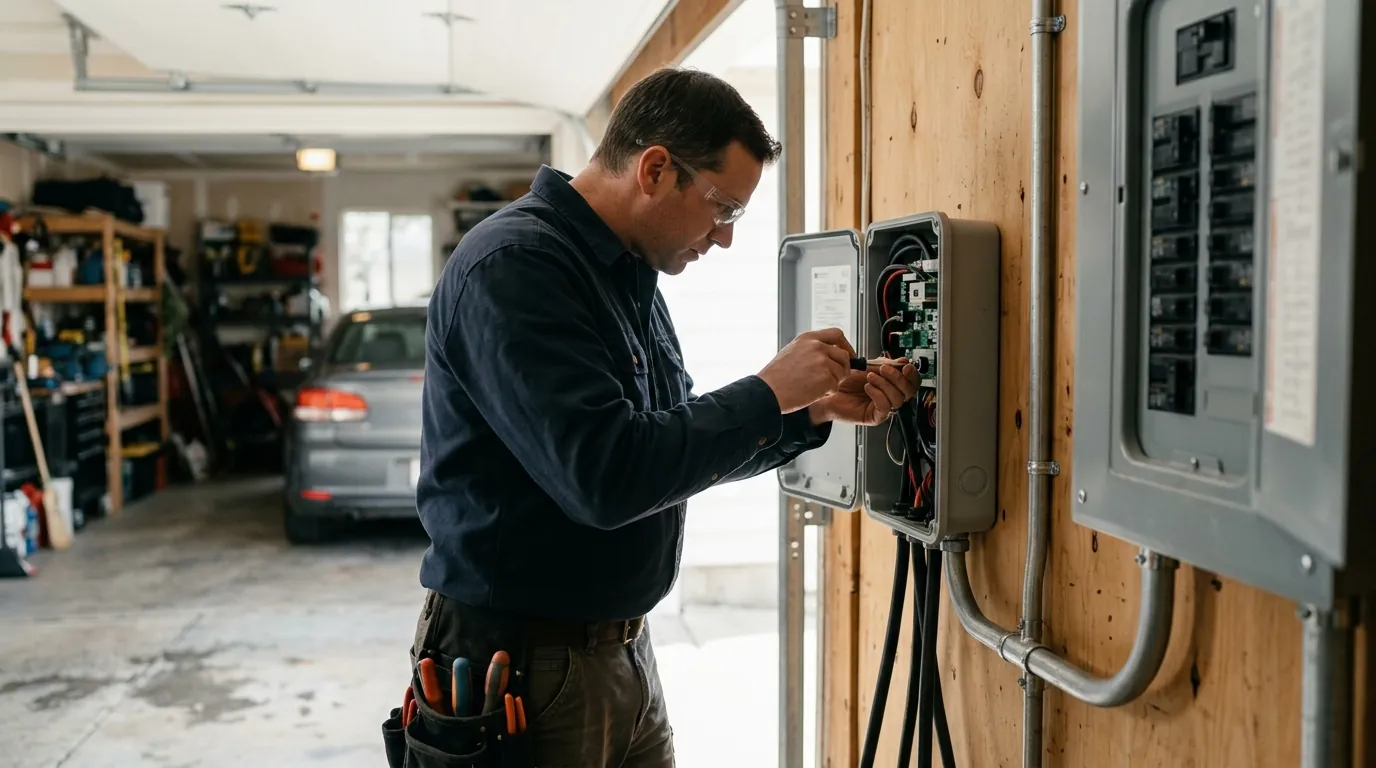
A garage charger is the most common install: a wall-mounted unit or a 240 volt receptacle for a plug-in charger, on its own circuit from the panel. Because the NEC treats EV charging as a continuous load, the breaker and wire are sized at 125 percent of the charging current, so a charger set to draw 40 amps needs a 50 amp circuit. Hardwired units avoid the wear a receptacle takes from repeated plugging and are often the better choice outdoors. A receptacle lets you swap chargers later. Either way we set the charger output to match the circuit, then test it under a real charging session before we leave.
Driveway and pedestal chargers
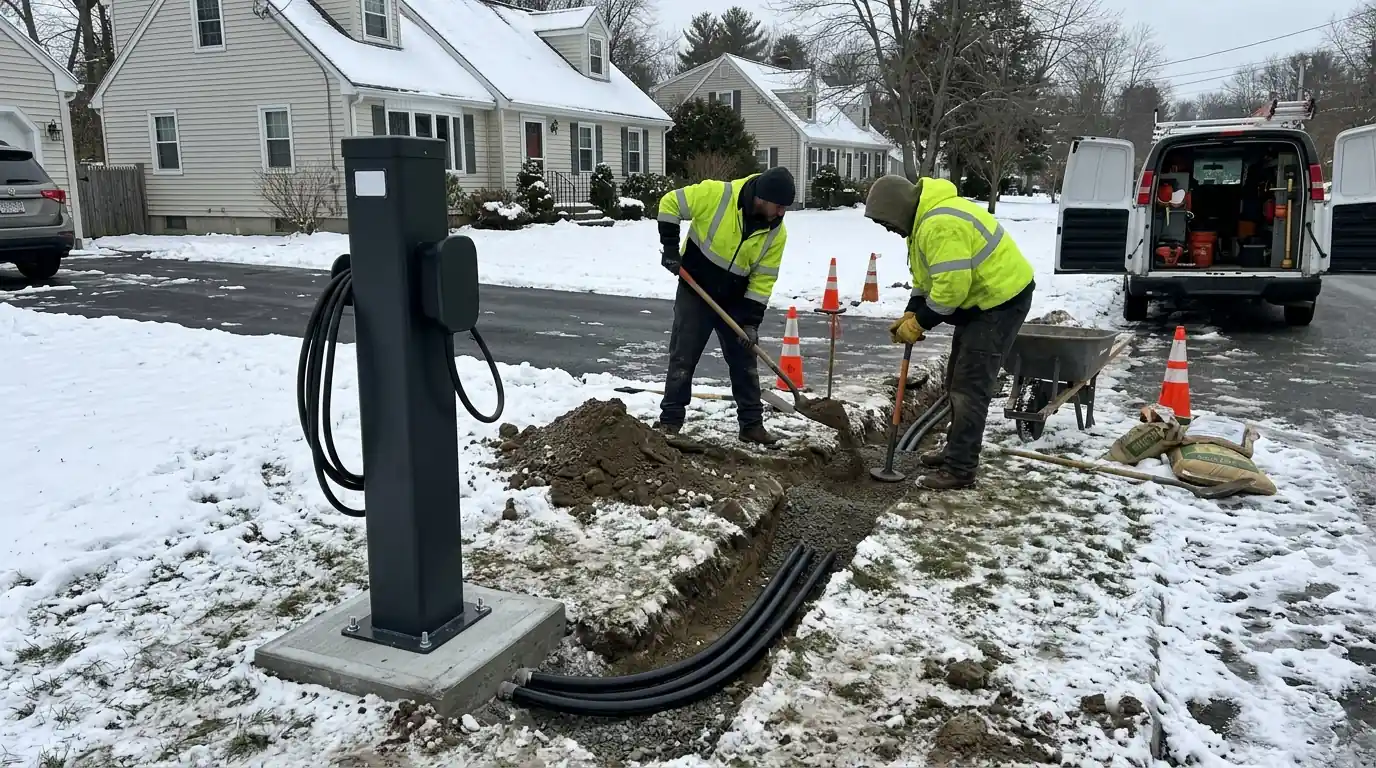
If you park outside, the charger goes on the house wall nearest the driveway or on a pedestal post at the parking spot. A wall mount is simpler and cheaper to wire. A pedestal needs an underground run in conduit, which means trenching across the yard or under a walkway, at the burial depth the code sets for the wiring method. Outdoor chargers need a weather-rated enclosure and a cord long enough to reach the charge port without stretching across a path. In winter, snowbanks and plows matter, so we place the post where it will not get buried or clipped by a shovel.
Chargers on a full panel
Plenty of Boston panels have no spare spaces and little spare capacity. That does not always mean a service upgrade. Many chargers can be set to a lower current, and a load management device can watch the whole house and throttle the charger when the dryer, oven and heat pump are all running. The 2023 NEC allows a managed system to be sized on its controlled maximum rather than the charger nameplate. When the load calculation still comes up short, the honest answer is a panel or service upgrade, and we tell you that before you buy hardware you cannot run at full speed.
Not sure your panel can take a charger? Call and we will run the numbers.
Call (617) 843-6591What decides the cost of an EV charger install
An EV charger job is priced on the distance and the panel, more than on the charger. These are the factors that move it.
- Distance from the panel. A garage beside the panel is a short run. A detached garage or a driveway across the yard is not.
- Panel capacity. A panel with room needs one breaker. A full one needs load management, a subpanel or an upgrade.
- Charger current. A higher charging current means heavier wire and a larger breaker on the same run.
- Hardwired or plug-in. Hardwiring takes a little longer on site but skips the receptacle and its upkeep.
- Trenching and conduit. Pedestal and detached garage installs add digging, conduit and surface repair.
- Permit and inspection. Work that needs a permit adds the filing and an inspection visit.
EV programs to check before you buy hardware
Before you order a wall charger, it pays to check two websites. Eversource has a home EV charging program for customers in Massachusetts, and the state utility regulators keep a resource page listing the charging programs open to residents. Some offerings tie their benefits to specific equipment or to a charger that can connect to a network, so the hardware you pick can affect what you qualify for. We install whatever unit you choose, run the dedicated circuit at the right size, and give you the install details that program paperwork usually asks for.
What a charger install covers
- Load calculation for the existing service
- Dedicated 240 volt circuit sized to the charger
- Breaker added or panel space made
- Charger mounting and output setting
- Weather-rated hardware for outdoor installs
- Permit filed on work that needs one
- Test charge with your car and labeled panel directory
How long a charger install takes
A wall charger in a garage that shares a wall with the panel is often a half-day job. A detached garage or a pedestal across the driveway takes a full day or more, mostly for trenching and conduit. If load management or a subpanel is part of it, plan on another few hours. A service upgrade has its own utility schedule.
From load calculation to first charge
Ask about the car and parking
We note the charger you want, where you park and how far you drive each day.
Load calculation
We add up the house loads against the service size to see what current the charger can have.
Plan the run
Route, wire size, breaker and mounting spot, agreed with you before work starts.
Install and set the charger
Circuit run, charger mounted, output set to match the breaker.
Test a real session
We charge your car, check voltage at the charger under load and label the panel.
EV charger questions from Boston drivers
If you drive under about 30 miles a day and park for 12 hours, a 120 volt outlet can keep up in mild weather. Most Boston drivers move to Level 2 for winter and for longer trips.
Often yes, at a reduced charging current or with load management. A load calculation tells us what your service can spare once heat, cooking and laundry are counted.
Hardwired is sturdier outdoors and removes a receptacle that wears from daily plugging. Plug-in makes it easy to move or replace the charger later. We wire either and set the charger to match the circuit.
Some chargers can share one circuit between two units and split the current between them. Charging is slower when both cars plug in at once, but it avoids running a second large circuit from a crowded panel.
Yes, if it is a listed product suited to the location, indoor or outdoor. Check any utility program rules before you buy, since some programs only count approved models toward their offers.
A garage install near the panel is usually done in a day or less. Trenching to a pedestal, a long run to a detached garage or a panel upgrade adds time, and we tell you which applies at the quote.