Updated October 2026
Straight answer
Whole-house surge protection in Boston means a surge protective device mounted at your main panel or meter, wired to clamp voltage spikes before they spread through the circuits. It works only as well as the grounding behind it. Current code calls for one when a dwelling service is installed or replaced, and we check grounding and bonding on every install.
What a surge does to modern equipment
A surge is a short spike in voltage, lasting millionths of a second. Big ones come from lightning or utility switching. Small ones happen many times a day inside the house, whenever a compressor, pump or motor cycles off. Each small one does a little damage to electronics, and the circuit boards in heat pumps, ranges, washers and EV chargers are where it adds up.
A surge protective device at the panel diverts that excess energy to ground before it spreads through the branch circuits. It does not stop a direct lightning strike, and it does not replace the strip protecting your computer. What it does is take the edge off every surge that enters or starts in the house, on every circuit at once.
Layers of surge protection we install
Panel-mounted surge devices
A Type 2 device mounts at the main panel, usually on a two-pole breaker with short leads, and protects every circuit fed from that panel. A Type 1 device can go on the line side of the main, including at the meter, and handles surges arriving on the service before they reach the panel. Lead length matters: every inch of wire between the device and the bus weakens how well it clamps, so we mount it as close as the panel allows and keep the leads straight. Most devices have an indicator light that shows when the protection has been used up, and that is the cue to replace it.
Point-of-use protection
Point-of-use protection is the plug strip or outlet with surge protection built in, rated as a Type 3 device. Its job is the last few volts a panel device lets through, plus surges that come in on cable, phone or network lines the panel never sees. We recommend both layers for computers, home theater gear and network equipment. Cheap strips wear out silently, so a strip that has been through a few storms may be doing nothing. Point-of-use devices are not a substitute for the panel device, because they cannot protect a hardwired range, heat pump or furnace board.
Generator and EV equipment protection
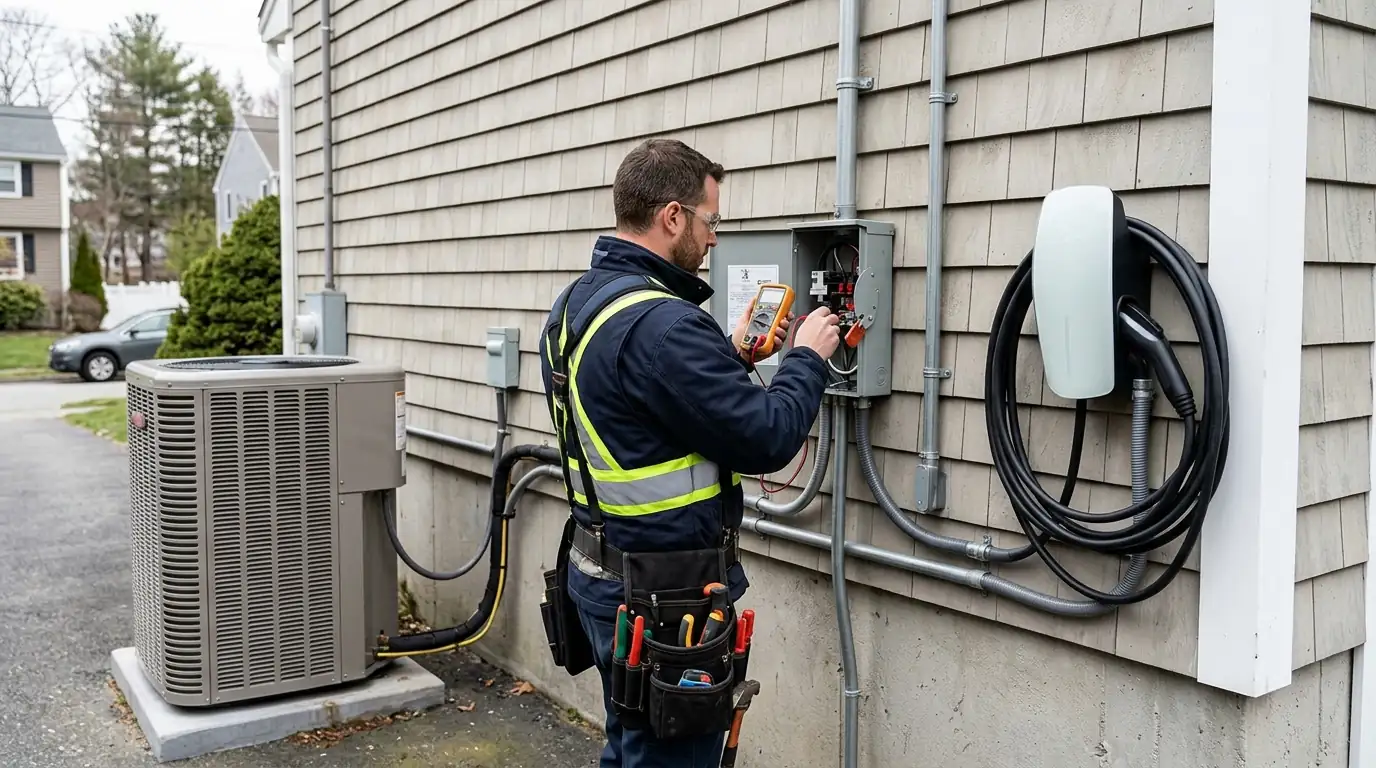
Standby generators, transfer switches and EV chargers all carry electronics that do not tolerate spikes well. A generator switching in and out can itself create surges, and a charger at the end of a long feeder to a garage can pick up surges along the way. For these we sometimes add a second device at a subpanel or at the equipment, in addition to the one at the main. Some charger and generator makers call for surge protection in their installation instructions, and we follow those where they apply.
Protect the boards in your heat pump and charger. Call to add a surge device.
Call (617) 843-6591Surge protection under Massachusetts code
An EV charger is often what starts a surge protector conversation. Eversource offers Massachusetts customers a program for home EV charging, and people who add a charger through it end up with a car, a smart charger and often a heat pump, all full of electronics a spike can damage. Current code also calls for surge protection when a dwelling service is replaced or upgraded. A whole-house protector at the panel handles surges arriving from the utility side and blunts some created inside the house by motors and compressors. We pair it with point-of-use strips for sensitive gear.
What affects the price of surge protection
Surge protection is one of the smaller panel jobs, and the price mostly depends on where the device goes.
- Device type. A Type 1 device at the meter takes more coordination than a Type 2 at the panel.
- Panel space. A full panel may need breakers rearranged to free a two-pole space close to the bus.
- Grounding condition. A missing ground rod or broken bond has to be fixed first for the device to work.
- Extra devices. Subpanels, detached garages and generator transfer switches can each take their own device.
- Combined work. Adding a surge device during a panel upgrade costs less than a separate visit.
How a surge device goes in
Check the grounding
We test the grounding electrode connection and the water and gas bonding first.
Pick the device and spot
Type 1 or Type 2, placed for the shortest possible leads.
Install
Power off, device mounted and connected, leads kept short and straight.
Confirm the indicator
Power restored and the status light checked, so you know what normal looks like.
Advise on point-of-use
We note which electronics should also have a good surge strip.
Type 1, Type 2 or Type 3?
Surge devices are rated by where they install, and a sound plan uses more than one location.
| Device | Where it goes | What it protects |
|---|---|---|
| Type 1 | Line side of the main, including at the meter | Service entrance and everything downstream |
| Type 2 | At the main panel or a subpanel | Every branch circuit fed from that panel |
| Type 3 | At the outlet or in a plug strip | The electronics plugged into it |
Surge protection questions
It handles surges from nearby strikes and from the utility lines, but no device stops a direct strike on the house. It does protect against the far more common smaller surges.
It depends on how many surges it absorbs and how large they are. The device gives up part of its capacity each time it clamps. When the indicator shows the protection is gone, it gets replaced.
Yes, for computers, televisions and network gear. The panel device handles the big energy, and the strip handles what remains plus surges that come in on cable and network lines.
The 2023 NEC requires it when a dwelling service is installed or replaced, so a panel upgrade usually includes one. Adding one to an existing service that is staying in place is your choice.
It helps protect the inverter board and controls, which are among the most surge-sensitive and expensive parts in the house. Some heat pump makers recommend surge protection in their instructions.