Updated October 2026
Straight answer
Meter socket and service mast repair in Boston covers the homeowner's side of the service: the mast, weatherhead, meter socket and service entrance cable. When a storm bends the mast or a socket corrodes, the utility will only reconnect to equipment in sound shape. We make it safe, rebuild the damaged parts and coordinate the disconnect and reconnect.
Signs the service equipment is failing
Mast leaning or bent
The pipe has been strained by the drop or a limb.
Rust on the meter enclosure
Water is getting into the socket and attacking the jaws.
Meter loose in its socket
Worn or corroded jaws are no longer holding it firmly.
Drop wires sagging low over the yard
The attachment point may be pulling away from the house.
Scorch marks around the meter
Heat from a poor connection at the jaws.
From damage to reconnection
Assess from the ground
We look at the mast, drop and socket and decide what is safe to approach.
Coordinate the utility
We arrange the disconnect, or confirm the service is already down.
Rebuild your side
Mast, weatherhead, socket and service cable are replaced as needed.
Inspection where required
Work that needs a permit is inspected before reconnection.
Reconnect and verify
The utility reconnects and we check voltage at the panel.
Where your side of the service begins
Overhead service enters most older houses through a vertical pipe called the mast, capped by a weatherhead that keeps rain out of the conductors. The drop wires from the pole attach to the house near the top, and the conductors run down to the meter socket and on to the panel. Everything from the weatherhead to the panel is the owner's responsibility, so storm damage there is your repair, not the utility's.
This work happens around energized utility conductors that we don't cut ourselves. The usual sequence is that the utility disconnects, or the service is already down, we repair or replace the damaged equipment, the work is inspected where required, and the utility reconnects. Getting those steps lined up quickly is half the job, especially after a storm when every crew is busy.
Mast and socket damage we repair
Storm-damaged service mast
Wind and falling limbs can bend a mast backward, crack the roof boot around it or tear it off the wall brackets. A bent mast strains the conductors inside and can pull the meter socket out of level, opening gaps where water gets in. Straightening a bent mast isn't a safe fix, because the metal has already weakened. We replace the mast, weatherhead and fittings, reseal the roof penetration or wall bracket, and check that the attachment point can carry the drop. A new mast sometimes has to be taller to meet clearance rules, which can change the roof work involved.
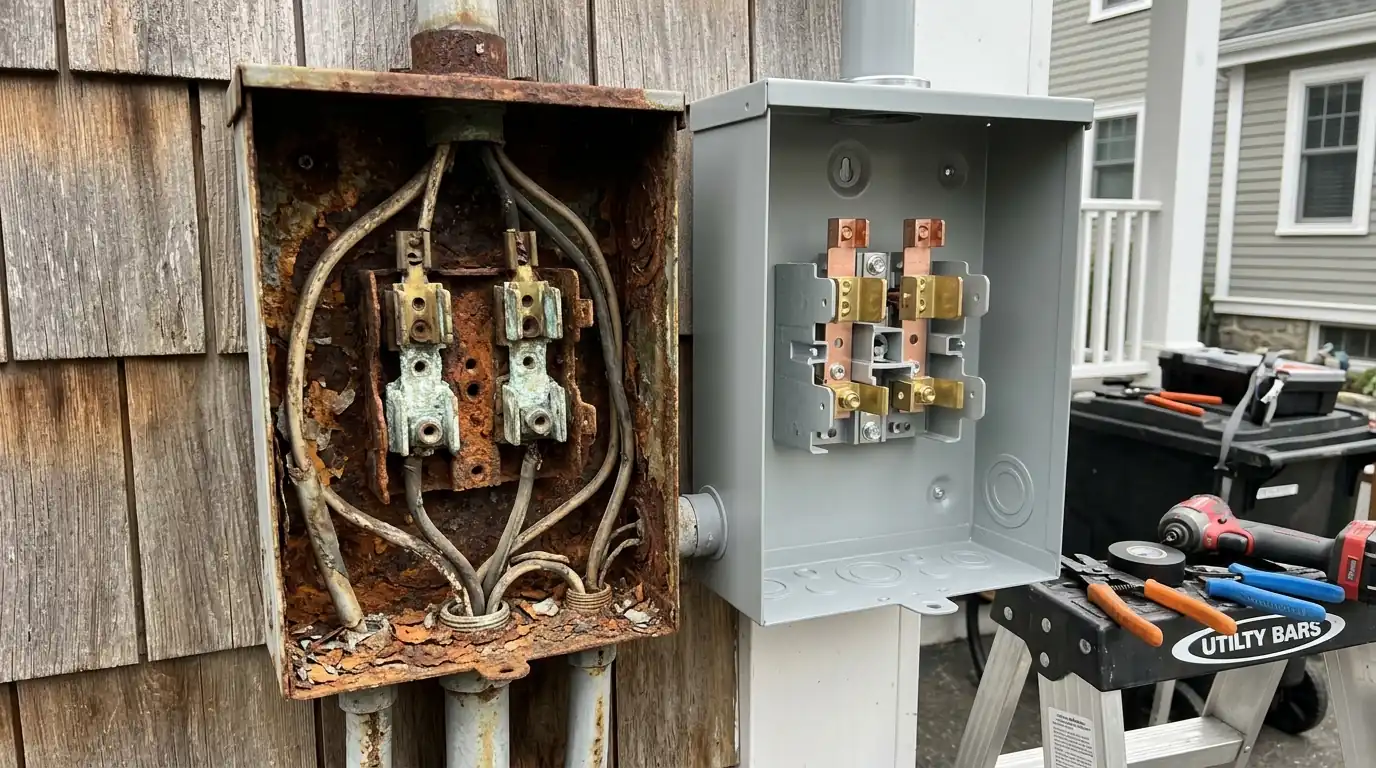
Corroded meter socket
Meter sockets sit outside for decades, and water that gets in through a cracked hub or a failed seal rusts the jaws that hold the meter. Corroded jaws grip poorly, heat up and can scorch the meter base. Signs include a rusted enclosure, a meter that sits loose, or flicker the utility traces back to the house. We replace the socket with one rated for the service, replace damaged service cable where it enters, and seal every entry. In a multi-family house with several meters, a gang socket may be the right replacement, which means the utility has to reset each meter.
Ice-pulled service drop
Ice on the drop wires, or a heavy limb resting on them, can pull the attachment point out of the house, tear the weatherhead off or bend the mast at the roofline. The utility owns the wires and will repair them, but first it needs a solid point to attach to. We install a new mast or attachment, replace the weatherhead and any damaged service conductors, and make sure the drop clears walkways and driveways by the required height. If the power is out while you wait, we tell you what to report to the utility and keep you posted on where the job stands.
Mast bent or meter pulled loose? Call and we will rebuild it.
Call (617) 843-6591What to do and what to leave alone
Safe for a homeowner
- Stay clear of a bent mast or downed drop and keep others away
- Report a pulled drop or sparking at the meter to the utility
- Take photos from a safe distance for your insurer
- Switch off the main breaker if you can reach it from a dry spot
Leave to an electrician
- Straightening or bracing a mast
- Opening or removing the meter
- Resealing a meter socket or weatherhead
- Any work near the drop wires
Never pull a meter or touch the drop. Those conductors stay live until the utility disconnects them, and there is no breaker between you and the street.
Storms, historic districts and town utilities
Rusted meter sockets and leaning masts are common on Boston houses, since the outside of the service takes years of ice, wind and salt in the air near the harbor. Storm damage adds bent masts and torn weatherheads, and the utility will not reconnect until our side is sound. On Beacon Hill there's an extra step. The neighborhood is one of the city's historic districts, and its architectural commission reviews outside changes that people can see from the street. Moving a meter, raising a mast or shifting the service entrance can fall under that review, so we plan to keep the existing location where we can.
How long until the power is back
The repair itself is often a day or less once materials are on hand. Total time depends on the utility, which has to disconnect and reconnect, and on an inspection where the work needs a permit. After a big storm, utility schedules stretch, so we line up our part early to keep the wait as short as it can be.
What drives the cost of mast and socket work
Mast and socket repairs are priced on what is damaged and how the house takes its service, and you hear the cost before work starts.
- What failed. A weatherhead alone is smaller work than a full mast, socket and cable.
- Mast height and roof. Masts through the roof need flashing and may need extending for clearance.
- Single or multiple meters. Gang sockets on multi-family houses are more involved than a single socket.
- Service cable condition. Cracked or wet service entrance cable gets replaced along with the socket.
- Permit and inspection. Service work that needs a permit adds filing and an inspection step.
- Storm timing. Repairs after a major storm compete with heavy demand for crews and parts.
Meter socket and mast questions
The homeowner. The utility owns the drop wires and the meter, but the mast, weatherhead and meter socket are part of the house.
Usually not until it's repaired. The utility reconnects only to equipment that is in sound condition and properly attached.
Yes. We coordinate the disconnect and reconnect, and we tell you what to report so the request goes in correctly.
Rust means water is getting in. Corroded jaws can heat and fail, so it's worth having the socket checked before it causes an outage.
Many policies cover storm damage to the house, but each insurer decides. We can give you a written description of the damage and the repair.
Sometimes, if there's a reason and the utility agrees. In a historic district, a change visible from the street may also need approval first.