Short answer
When a breaker keeps tripping, first notice how it trips. Tripping after several minutes under load usually means an overloaded circuit. Tripping the instant you reset it points to a short or ground fault. Unplug everything on the circuit, reset once, then add devices back one at a time. If it trips with nothing plugged in, or you smell burning, leave it off and call an electrician.
Read the trip: timing tells you a lot
Standard breakers trip on two signals. A thermal element heats up and trips on sustained overload, which takes seconds to minutes. A magnetic element trips instantly on the huge current of a short circuit. So a breaker that holds for ten minutes while a space heater and a hair dryer run, then trips, is telling a different story from one that snaps off the moment you push the handle.
Newer breakers add more signals. A GFCI breaker trips when current leaks to ground, as little as a few milliamps. An AFCI breaker trips when it detects the signature of arcing in the wiring or a cord. Many newer AFCI and dual-function breakers have a small indicator or a sequence that shows which kind of fault caused the trip. Note it before you reset.
- Delayed trip under load: likely overload
- Instant trip on reset: likely short or ground fault
- Trips with a test or indicator on a GFCI or AFCI breaker: leakage or arcing
- Trips at random with nothing new plugged in: loose connection or failing breaker
Safe checks a homeowner can make
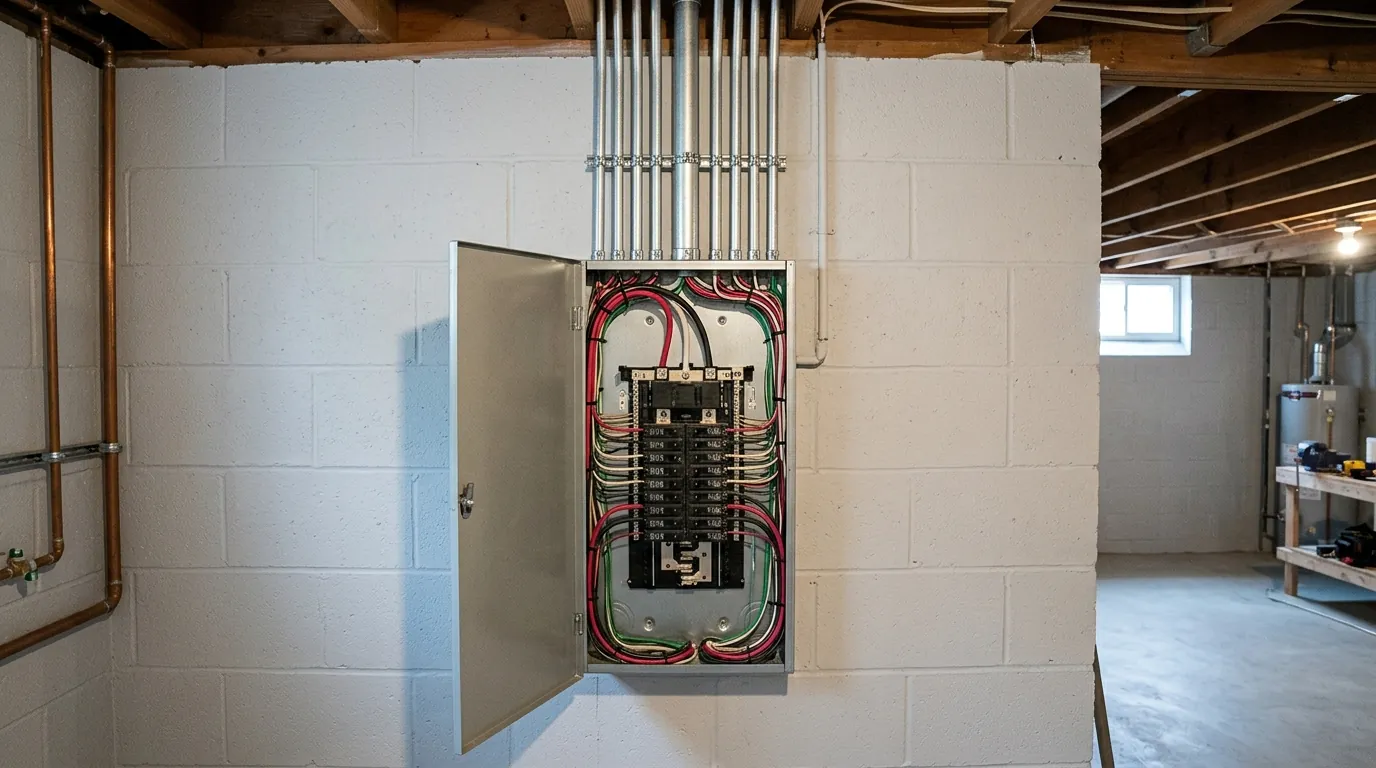
Start at the panel. Find the tripped breaker: its handle sits in the middle or slightly off the on position. Push it firmly to off first, then back to on. If you can, find out what is on that circuit by noting what went dark. Panel directories in older houses are often wrong, so trust what you see rather than the label.
Unplug everything on the circuit, turn off its lights, and reset. If it holds, plug devices back in one at a time, waiting a minute between each. The one that trips it is your suspect, often a space heater, a window air conditioner, a toaster oven or an old extension cord. Try the suspect on a different circuit. If it trips there too, the appliance is the problem.
Breaker still tripping with everything unplugged? Call, we answer 24/7.
Call (617) 843-6591When the circuit is simply overloaded
Overloads are the most common cause in older Boston houses, where one 15 amp circuit may feed two bedrooms and a hallway. Window air conditioners and portable heaters are the usual culprits, because each can draw most of a circuit on its own. Kitchens wired decades ago often put the microwave, toaster and coffee maker on a single circuit.
The fix is to move a heavy load to another circuit or add a dedicated circuit for it. Replacing the breaker with a larger one is not a fix. The breaker protects the wire, and a 15 amp wire on a 20 amp breaker can overheat inside the wall long before anything trips. If someone has already done that in your panel, it should be corrected.
Signs it is a wiring fault, not an appliance
If the breaker trips with every device unplugged and every switch off, the fault is in the wiring itself: a damaged cable, a nail through a wire, water in a box, or a failed splice. An instant trip on reset with nothing connected is the clearest sign. So is a trip that follows rain, which suggests water reaching an outdoor outlet, a fixture or a basement junction box.
Burning smells, warm outlet covers, discolored plates, crackling sounds and lights that flicker on the same circuit all suggest a loose connection that is heating up. Those are reasons to leave the breaker off and call. Repeatedly resetting a breaker onto a fault puts stress on the wiring and the breaker, and can start a fire in an old wall.
- Trips with nothing plugged in
- Burning or hot plastic smell
- Warm or discolored outlet or switch plate
- Trips after rain or snowmelt
- Buzzing or crackling from a box or the panel
When the breaker or panel is the problem
Breakers wear out. A breaker that trips well below its rating, feels loose on the bus, or is hot to the touch may need replacement. Some older panel brands carry a poor reputation. Federal Pacific Stab-Lok breakers in particular are known for failing to trip when they should, which is the opposite problem and a more dangerous one. Zinsco panels have their own history of bus problems.
AFCI breakers occasionally trip on certain motors, treadmills or older vacuum cleaners. That is worth testing, but do not assume a nuisance trip. AFCIs often catch a real arcing fault, such as a pinched cord or a backstabbed outlet that has loosened. An electrician can test the circuit and the breaker rather than guess.
What an electrician does on a tripping circuit
On site, the electrician confirms what is on the circuit, measures current under load, and tests insulation resistance on the wiring with the loads disconnected. Testing finds faults that a visual check misses, such as a slowly failing splice or moisture in a buried cable. The breaker itself gets checked too.
The repair might be a new receptacle, a remade splice, a replaced section of cable, a dedicated circuit for a heavy appliance or a new breaker. Massachusetts enforces the 2023 National Electrical Code with state amendments in 527 CMR 12.00, so replacement devices and new circuits follow current rules, including AFCI and GFCI protection where required.
Where we can help
Tripping breaker questions
Resetting once after unplugging the circuit is reasonable. Resetting again and again onto a fault is not. If it trips with nothing connected, or you smell burning, leave it off and call.
No. The breaker size matches the wire. A larger breaker lets the wire overheat before it trips, which is a fire risk. Move the load or add a circuit instead.
Water is probably reaching an outdoor outlet, a light or a buried cable on that circuit and leaking current to ground. The GFCI is working correctly. The wet connection needs to be found and repaired.
It may not be the breaker. Many bathrooms are protected by a GFCI outlet elsewhere on the circuit, sometimes in another bathroom or the garage. Press the reset on GFCI outlets nearby before touching the panel.
Yes. Breakers can weaken and trip below their rating, or loosen on the bus. Some older brands are known for failing to trip at all, which is worse. An electrician can test it.
If there is a burning smell, heat, sparking or the trip took out heating or a sump pump in winter, yes. A single overloaded circuit with nothing else wrong can usually wait until morning with the breaker off.