Short answer
When power is out in part of the house, first check for a tripped breaker and a tripped GFCI outlet, since one GFCI can feed several rooms. If neither is the cause and half the house is dead or lights are dimming and brightening, you may have a lost leg or a loose neutral, which needs an electrician or the utility right away.
Start at the panel, not at the dead outlet
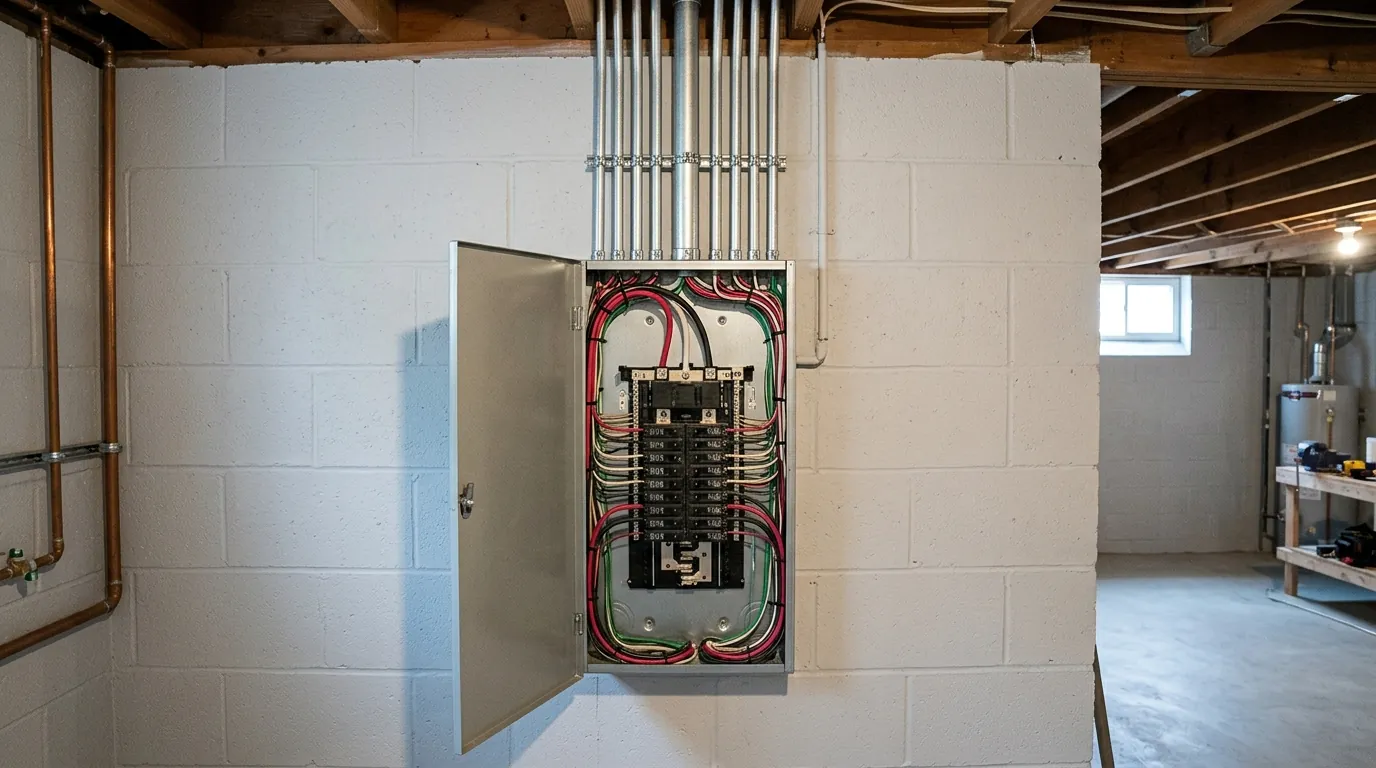
Open the panel door and look along both rows of breakers. A tripped breaker does not always sit fully off; often the handle rests in the middle, a little out of line with its neighbors. To reset it, push it firmly all the way to off, then back to on. If it trips again right away, leave it off, because something on that circuit is drawing too much current or has a fault.
If the house still has an old fuse box, look for a fuse with a blackened window or a broken strip inside. Replace it only with the same size fuse, never a larger one, and if the new fuse blows quickly, stop there. Repeated trips or blown fuses are the system telling you about a problem it is designed to catch.
- Handle sitting in the middle or out of line
- Breaker that feels loose or warm to the touch
- A burning smell near the panel, which means stop and call
- Fuse window darkened or showing a broken link
Check the GFCI outlets you forgot about
A single GFCI outlet protects every outlet wired downstream of it, and that downstream run can wander. A tripped GFCI in a garage can kill outlets on the back porch, and one in a basement can take out a bathroom upstairs. Builders and past owners rarely labeled any of this, so a dead outlet with no tripped breaker often turns out to be a GFCI that nobody knew was upstream.
Walk the house and press the reset button on every GFCI you can find: bathrooms, kitchen counters, laundry, garage, basement, exterior walls and sometimes beside the panel. If one will not reset, the circuit may have no power reaching it, the device may have failed, or water may be sitting somewhere on that circuit. Outdoor and basement GFCIs that trip after rain are a common example.
Lights swinging bright and dim? Unplug electronics and call us now. We answer 24/7.
Call (617) 843-6591Half the house dead: the lost leg
A house service brings in two hot legs, each at 120 volts, which together make 240 volts for big appliances. If one leg drops, roughly half the circuits go dead while the rest keep working. The clues are distinctive. The dryer may spin but not heat, the electric range may have some burners and not others, and a heat pump or central air unit may not start at all.
A lost leg can start at the utility, at the service drop, at the meter or at the main breaker. Check whether neighbors have the same trouble. If they do, report it to your utility: in Boston that is Eversource, while Danvers is served by its own municipal electric division. If only your house is affected, an electrician needs to test the service at the meter and the main to find where the connection failed.
Lights brightening and dimming: the loose neutral
The neutral is the return path that keeps the two legs balanced. When it loosens or breaks at the service, the voltage on each side starts to swing with whatever is running. Lights in one room glow too bright while lights in another go dim, and the swing gets worse when the refrigerator, a hair dryer or a microwave starts up. Electronics may shut off, reboot or fail outright.
This one is urgent. Overvoltage on one leg can damage anything plugged into it, and the loose connection itself can overheat. Unplug sensitive electronics, switch off large appliances, and call for an electrician or the utility right away. Large nor'easters have left many Eversource customers in Massachusetts without power, sometimes for days, and storm damage to a service drop is a frequent cause of neutral trouble once power comes back.
What you should not try on your own
Resetting breakers and GFCIs is safe and reasonable. Opening the panel cover, tightening connections at the main, or pulling the meter is not, because the conductors coming in from the street stay energized even with the main breaker off. Running extension cords from a working room to a dead one to get by also hides the problem and can overload the circuit you are borrowing from.
Water is its own rule. If a dead circuit runs through a basement that has flooded or near a ceiling that is leaking, keep away from the panel if you are standing on a wet floor. Let the utility cut service at the street if you cannot reach the main safely from dry ground.
What an electrician does when the cause is not obvious
When a breaker is on, the GFCIs are reset and the circuit is still dead, the fault is usually a failed connection somewhere along the run. In older Boston houses that often means a backstabbed outlet that let go, a splice buried in a ceiling box, or a connection on the neutral bar in the panel. We trace the circuit from the panel outward, test each box, and repair the connection that failed rather than guessing.
On a lost leg or loose neutral we measure voltage at the panel and the meter under load. If the fault is on the utility side, you get a clear description to give the utility. If it is on the house side, such as a burned lug on the main or a loose neutral at the meter socket, we repair it and test the service before turning circuits back on.
Where we can help
Questions readers ask
Each room is fed by one or more circuits, and those circuits split between two legs of your service. A tripped breaker, a tripped GFCI, a failed connection or a lost leg can each kill some circuits while others keep running.
Look for a tripped GFCI upstream, often in a bathroom, garage, basement or outside. If every GFCI resets and the outlet is still dead, a connection has likely failed in a box along the circuit, which needs tracing.
Yes. A loose neutral lets voltage swing between the two sides of the house, which can overheat connections and destroy electronics. Unplug what you can, switch off big appliances and call right away.
If neighbors have the same problem, or a service line is down, call the utility first. If only your house is affected and the breakers are fine, an electrician can test the service and find the failed connection.
A dryer uses both legs of the service for its heating element and one leg for its motor. If one leg is lost, the drum can still turn while the element stays cold. That pattern is a strong sign of a lost leg.
Reset it once. If it trips again right away, leave it off. Repeated resetting forces current through a fault the breaker is trying to stop, and that is how wiring and devices overheat.