Short answer
A standby generator starts on its own and runs through an automatic transfer switch, so it suits households that cannot be without heat, sump pumps or medical equipment. A portable generator costs less to set up but needs an interlock or transfer switch, someone to start and refuel it, and a safe spot far from the house.
Why nor'easter outages change the calculation
Large nor'easters have left many Eversource customers in Massachusetts without power, sometimes for days. A short summer outage is an inconvenience. A multi-day winter outage means a cold house, a sump pump that cannot run, frozen pipes in older homes and a refrigerator full of food on the line. That length is what makes people move from a few flashlights to a real plan.
Coastal storms add flooding to the picture. Parts of Quincy have flooded badly enough to force evacuations, and in any low area the generator, its inlet and its transfer equipment need to sit above the level water can reach. A generator that drowns in the first hour of a storm surge does not help anyone.
How a standby generator works
A standby unit is permanently installed outside on a pad, runs on natural gas or propane, and connects through an automatic transfer switch. When utility power drops, the switch senses it, the generator starts, and after a short pause the switch moves your house loads over. When the utility returns, it switches back and the generator shuts down on its own.
The advantages are that nobody has to go outside in the storm, the fuel supply does not run out on a natural gas line, and the unit can be sized for the whole house or for selected circuits. The trade-offs are a larger project, gas or propane work alongside the electrical work, and a pad location that meets clearance rules from windows, doors and vents.
- Starts and transfers on its own
- Natural gas or propane, no refueling trips
- Sized for the whole house or chosen circuits
- Needs a pad location with proper clearances
Want an inlet and interlock in before the next storm? Call and we will look at your panel.
Call (617) 843-6591How a portable generator connects safely
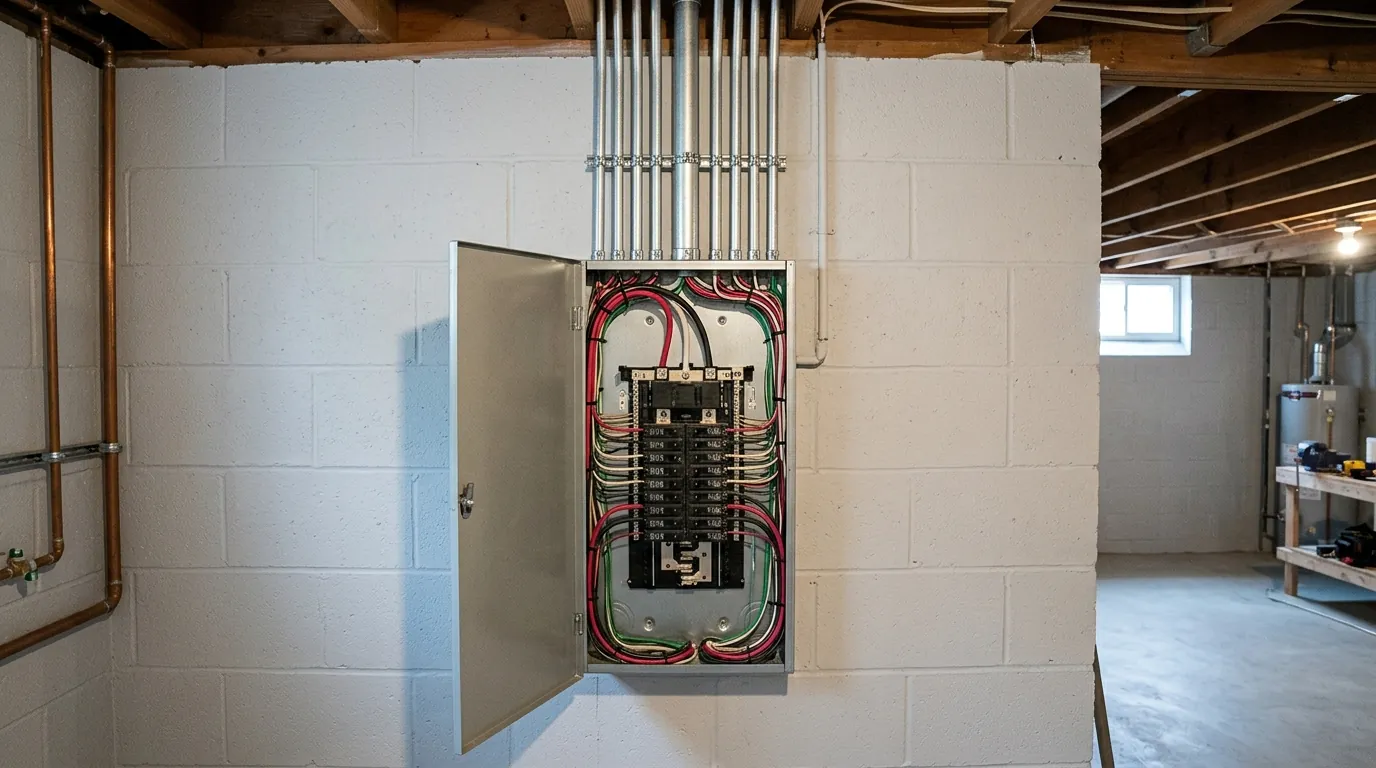
A portable generator should connect to the house through a power inlet box on the outside wall and either a manual transfer switch or a panel interlock. The interlock is a sliding plate that physically prevents the main breaker and the generator breaker from being on at the same time. You plug the generator cord into the inlet, switch the main off, slide the interlock and turn on the generator breaker, then pick which circuits to run.
A manual transfer switch does the same job with a small dedicated panel of selected circuits. Either way, the point is that the house can never be connected to both the utility and the generator at once. A portable unit asks more of you: starting it, refueling it with gasoline, and managing which circuits run so you do not overload it.
Never backfeed, and why it matters
Backfeeding means plugging a generator into a dryer outlet or a regular receptacle with a double male cord to push power into the house wiring. Without a transfer switch or interlock, that power flows out through your main and onto the utility lines. It can energize wires that line workers believe are dead, sometimes at much higher voltage after it passes through the transformer.
Backfeeding also puts your own house at risk when the grid comes back, because the generator and the utility meet at your panel. It is not a shortcut worth considering. If you own a portable generator and have no inlet or interlock yet, run appliances directly from the generator with heavy outdoor cords until proper equipment is installed.
Carbon monoxide: placement is a safety decision
Portable generators produce large amounts of carbon monoxide, which has no smell and can kill in minutes in an enclosed space. Never run one in a basement, garage, shed or enclosed porch, even with the door open. Set it outside, well away from windows, doors and vents, with the exhaust pointed away from the house and from neighbors.
Have working CO alarms on every level of the house and near sleeping areas before storm season. Standby units have their own required clearances, and keeping snow drifts away from the intake and exhaust matters during a long storm. Placement of the inlet box should follow the same thinking, so the cord run never pulls the generator closer to the house than it should be.
Sizing, permits and the utility side
Sizing starts with what you need running: heat, the sump pump, the refrigerator, some lights and outlets, and possibly a well pump or medical equipment. A gas boiler or furnace needs only a modest circuit for its controls and blower, while electric heat and well pumps ask far more of the generator. Heat pumps and central air have high starting current, which can push a portable unit past its limit, so it helps to check the equipment nameplates or have a load calculation done.
Generator installs are work that needs a permit, and in Boston that goes through the city's electrical permit and inspection process at Inspectional Services. Danvers has its own municipal electric division, and its Electric Service Policy Handbook covers new and upgraded services there. All of the work has to meet the 2023 National Electrical Code with Massachusetts amendments.
Where we can help
Questions readers ask
No. That is backfeeding, and it can send power onto the utility lines and injure line workers. Connect through an inlet box with an interlock or a transfer switch, or run cords directly to appliances.
An interlock is a plate on your main panel that stops the main and generator breakers from being on together. A transfer switch is a separate device that selects the power source. Both prevent backfeeding.
Sometimes, but heat pumps and central air units draw high current when they start. Check the nameplate and the generator rating, or have a load calculation done before you count on it.
Outside, well away from windows, doors and vents, never in a garage, basement or enclosed porch. Keep it dry and keep the exhaust pointed away from the house. Have CO alarms on every level.
Generator installations are work that needs a permit. In Boston that goes through Inspectional Services, and gas or propane connections have their own requirements. The electrician installing it should file the electrical permit.
For shorter outages or households that want silent, fuel free backup, a battery system can cover selected circuits. For multi-day nor'easter outages, many owners pair batteries with solar or a generator.