Short answer
An electrical panel upgrade in Boston means replacing the breaker panel, and often the service entrance, after a load calculation shows what the house needs. The electrician files a permit, coordinates the disconnect and reconnect with Eversource (or the Danvers municipal division in Danvers), swaps the equipment, and has the city inspect it before the utility restores power. The price follows the scope, not the panel itself.
Panel swap or full service upgrade: which one you are buying
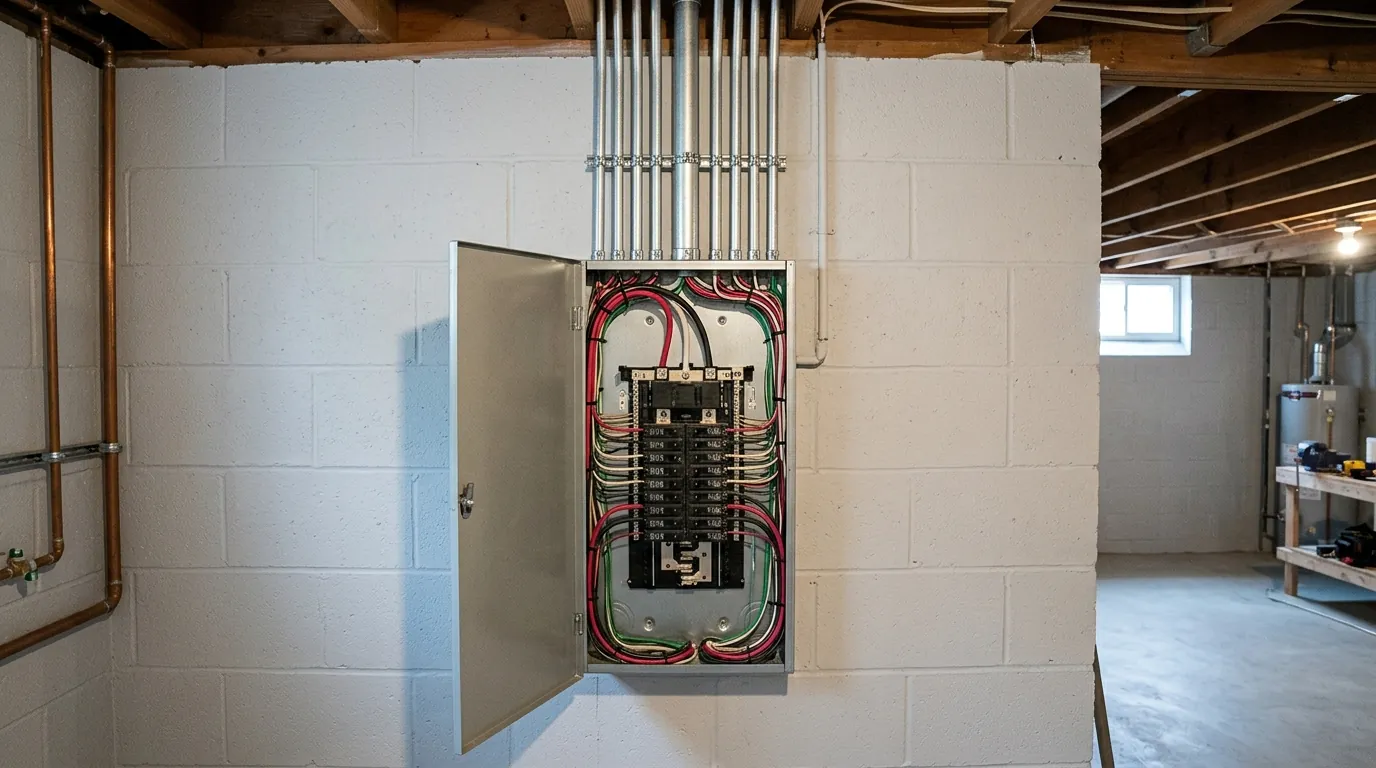
People say panel upgrade for two different jobs. The smaller one replaces the breaker panel itself and keeps the existing service size. That fits a house with a Federal Pacific or Zinsco panel, a fuse box, or a panel with no open spaces, where the wires from the street are already big enough. The utility still has to cut and restore power, but nothing changes on their side.
The bigger job raises the service, for example from 100 amps to 200. That means a new meter socket, new service entrance conductors, often a new mast or weatherhead on an overhead service, and a new grounding electrode system. The utility has to approve the larger service and may need to change its own wires. Most of the difference in price between two quotes comes from which of these two jobs the quote actually covers.
The load calculation decides the size
Before anyone orders a panel, the electrician should run a load calculation under Article 220 of the National Electrical Code. Massachusetts enforces the 2023 NEC with state amendments published as 527 CMR 12.00. The calculation adds up general lighting and receptacle load by square footage, then fixed appliances, cooking, laundry, water heating and heating or cooling equipment, and applies the demand factors the code allows.
The result tells you whether 100 amps is enough, whether 150 or 200 makes sense, or whether a load management device could let you skip the service upgrade entirely. Bring a list of what you plan to add in the next few years: an EV charger, a heat pump, an induction range, a basement apartment. Sizing for a known plan now is cheaper than doing the job twice.
- Square footage of finished living space
- Existing large appliances and their nameplate ratings
- Electric heat, heat pumps or central air, current and planned
- EV charging, hot tub, well pump or other large loads
Want a load calculation before you decide? We answer 24/7.
Call (617) 843-6591Working with Eversource or the Danvers municipal division
In Boston and most surrounding towns, the utility is Eversource. In Danvers, the town runs its own municipal electric division and publishes an Electric Service Policy Handbook that covers new and upgraded services, including where meters go and what the customer side has to provide. Either way, the electrician submits a service request, and the utility schedules the disconnect and reconnect.
Utility scheduling is often the longest part of the calendar. An upgrade to a larger service can require the utility to check its transformer and drop, which adds time. On the day, the utility cuts power at the pole or the meter, the electrician does the work, and power comes back after the inspection or the inspector's release. Expect the house to be dark for most of a working day.
Permit and inspection in Boston
Electrical work in Boston is permitted and inspected through the city's electrical permit process at Inspectional Services. A panel or service change is the kind of work that needs a permit, and in Massachusetts the permit is pulled by a licensed electrician, not by the homeowner. Ask to see the license number and make sure the permit is in the electrician's name before work starts.
The inspector looks at the panel, the breakers, the service conductors, the grounding and bonding, working clearance in front of the panel, and labeling. Towns outside Boston run their own wiring inspectors with their own scheduling. A finished permit matters later: buyers, lenders and insurers ask about panel work, and a closed permit answers the question.
What makes one job cost more than another
Two panel upgrades in the same neighborhood can be priced very differently. These are the conditions that move the number, so you can compare quotes on the same terms and ask the right questions.
- Service size: a same-size panel swap is a smaller job than raising the service
- Meter location: moving a basement meter outside, or relocating a panel, adds conductor runs and wall work
- Overhead or underground service: a new mast, weatherhead or conduit run changes the scope
- Grounding: many older houses need new ground rods and water pipe bonding brought up to current rules
- Circuit count and condition: brittle cloth wire or undersized branch circuits may need repair before they can land on new breakers
- Code-required breakers: current rules call for AFCI and GFCI protection on many circuits, and those breakers cost more than standard ones
- Multi-family buildings: a triple-decker with several meters and a house panel is a different project from a single-family house
Incentives, timing and planning ahead
Panel upgrade incentives tied to electrification are offered in Massachusetts in 2026, with eligibility that depends on the program. Some are linked to adding a heat pump or other electric equipment, and the paperwork usually has to be in place before work starts. Program terms change, so check the current rules with the program sponsor before you sign a contract, and ask your electrician what documentation they can supply.
If the house is old, plan the panel job together with any wiring work you already know about. Massachusetts has a larger share of pre-1940 houses than most states, and many of them still have knob and tube circuits or ungrounded cable that will not move happily onto a new panel. Finding that out before the utility cut is far better than finding it during.
Where we can help
Panel upgrade questions we hear most
The work itself is usually one long day with the power off. The calendar is longer: the permit, the utility request and the inspection all need scheduling, and a larger service can add a utility review of the transformer and drop.
Not always. A load calculation answers it. Many houses run fine on 100 or 150 amps, and a load management device can sometimes add an EV charger or heat pump without raising the service at all.
Yes, but plan for no power for most of the day. Refrigerators stay closed, sump pumps and medical equipment need a plan, and the heating system will be off while the panel is out.
They should. The electrician submits the service request, coordinates the disconnect and reconnect date, and meets the inspector. You may need to sign the utility application as the account holder.
Not by default. Existing circuits move to the new panel if they are in sound condition. Damaged, overheated or knob and tube circuits get flagged, and some may need repair before they can be reconnected safely.
Usually because they cover different scopes. Compare service size, meter and mast work, grounding, the number of AFCI and GFCI breakers, and whether the permit and utility coordination are included.